

 Posted by
 My mother was agitated for weeks. No one knew why. She couldn’t tell us. The staff assumed it was dementia progression. Then one aide sat beside her, took her hand, and asked slowly, “Mrs. Kim, is something hurting?” My mother pointed to her mouth. The aide looked inside and found a cracked tooth. Weeks of suffering because no one had asked the right way. Good communication isn’t a soft skill. It’s safety. It’s dignity. It’s the difference between suffering and relief.
The first strategy is learning to speak at the right level. Residents with dementia can’t process complex sentences. Staff who speak too fast or use too many words create confusion and agitation. The best aides use short, simple sentences. One instruction at a time. “It’s time to eat.” Not “Would you like to come to the dining room now because lunch is being served?” Simple isn’t patronizing. It’s accessible.
Non-verbal communication is just as important. Eye contact at the resident’s level. A gentle touch on the arm. Open posture. Staff who look at a resident while speaking, not at a chart or over their shoulder, convey respect. My mother responded to a warm smile more than any words.
For residents who can’t speak, staff need alternative strategies. Yes/no boards. Picture cards. Hand gestures. Simple signs. The best facilities train all staff, not just nurses, in basic alternative communication. An aide who can ask “thirsty?” with a hand motion can solve a problem before it escalates.
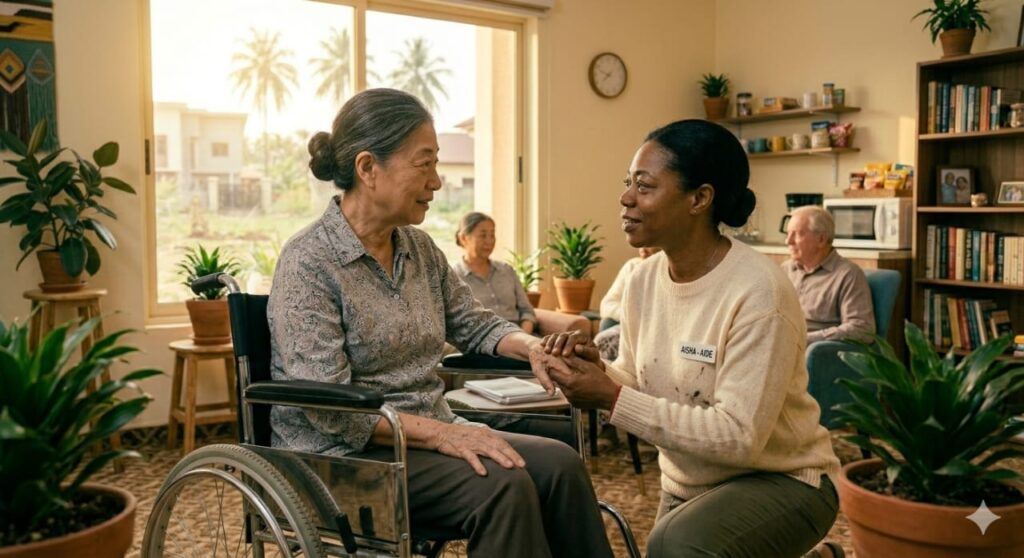
Active listening sounds basic, but it’s rare. Staff who truly listen don’t interrupt. They don’t finish sentences. They don’t assume they know what the resident will say. They pause. They wait. They let silence do its work. My mother’s favorite aide was the one who gave her time to find words. She never rushed. She never sighed. She just waited.
Validation is another critical skill. Many staff are trained to redirect or correct residents with dementia. When my mother said she needed to go home to her mother, the staff used to say, “Your mother is dead.” That was true. It was also cruel. Validation accepts the feeling behind the words. “You miss your mother. That’s so hard. Tell me about her.” The feeling is validated. The person is heard. The distress often passes.
For families, communication is equally important. Families want to know what’s happening, but they also want to feel heard. The best facilities have daily huddles and brief check-ins between shifts to share concerns. They have family portals where updates are posted. They return phone calls within hours, not days. My mother’s second facility had a “family support person” whose only job was communication. That person saved my sanity.
Staff-to-staff communication prevents errors. Shift changes are high-risk moments. The best facilities use standardized handoff tools. They don’t rush. They don’t assume. They mention what worked, what didn’t, and what to watch for. “Mrs. Kim was more confused than usual this afternoon. She refused her bath. Try again after dinner.” Those details prevent mistakes and reduce resident distress.
Conflict resolution training is essential. Staff will disagree with families. Families will disagree with each other. The best staff stay calm. They don’t take complaints personally. They say, “I hear you. Let me find out.” They follow up quickly. They don’t avoid hard conversations.
Finally, staff need communication support for themselves. Nursing home work is traumatic. Staff hear hard things, witness suffering, and carry heavy emotional loads. The best facilities have debriefing sessions after critical incidents. They have access to counseling. They have supervisors who ask “how are you doing?” and mean it.
If you have a loved one in a nursing home, watch how the staff communicates. Do they get to the resident’s level? Do they speak slowly and simply? Do they validate feelings? Do they listen? These small behaviors predict quality of care better than any star rating.
My mother’s cracked tooth was finally treated. The pain stopped. The agitation stopped. The aide who noticed didn’t have special training. She just communicated differently. She asked. She listened. She looked. That’s not rocket science. That’s basic humanity.
There’s so much more to learn about quality nursing home care. Our website is filled with articles on communication, advocacy, and staff training. Head over and explore, because the right words can change everything.
References
Agency for Healthcare Research and Quality. (n.d.). *Module 4: Teamwork and communication: Facilitator notes*. https://www.ahrq.gov/hai/quality/tools/cauti-ltc/modules/implementation/long-term-modules/module4/mod4-facguide.html
Ec(h)elbargh, K. M. (2023). *Organizational communication strategies in nursing homes*. *Innovation in Aging, 7*(Suppl 1), 1093. https://pmc.ncbi.nlm.nih.gov/articles/PMC10738260
NewLifestyles. (2020, December 15). *Ways to enhance staff communication in a nursing home*. https://newlifestyles.com/blog/ways-to-enhance-staff-communication-in-a-nursing-home
MedPro Insurance. (n.d.). *10 strategies for communicating effectively with senior care residents*. https://resource.medpro.com/effective-communication-senior-care-residents?iframe=true
Ec(e)rt Training. (2024, July 31). *How effective communication improves care in care homes*. https://ecerttraining.co.uk/resources/how-effective-communication-improves-care-in-care-homes/