
 Posted by
 When my mother’s doctor first mentioned hospice, I heard “we’re giving up.” I heard “there’s nothing more we can do.” I heard the end, spoken in clinical language that felt like a door slamming shut. My mother had fought hard. How could they suggest we stop fighting?
The doctor saw my face and sat down. “Hospice isn’t about stopping care,” she said gently. “It’s about changing the goal. The goal is no longer curing her disease. The goal is to give her the best possible quality of life for whatever time she has left.”
I didn’t believe her. Not really. But my mother was exhausted. The treatments were brutal, and she was getting sicker, not better. She asked to stop. And so, with a heart full of fear and guilt, I agreed to hospice. What happened next surprised me. The fight didn’t end. It transformed.
The first benefit I noticed was the team. Suddenly, we weren’t alone. A hospice nurse visited regularly, monitoring my mother’s symptoms and adjusting medications to keep her comfortable. A social worker helped us navigate the emotional and logistical chaos. A chaplain offered spiritual support, not pushing any particular faith, just present for whatever my mother needed. A home health aide helped with bathing and personal care. A volunteer came to sit with my mother so I could run errands or just breathe.
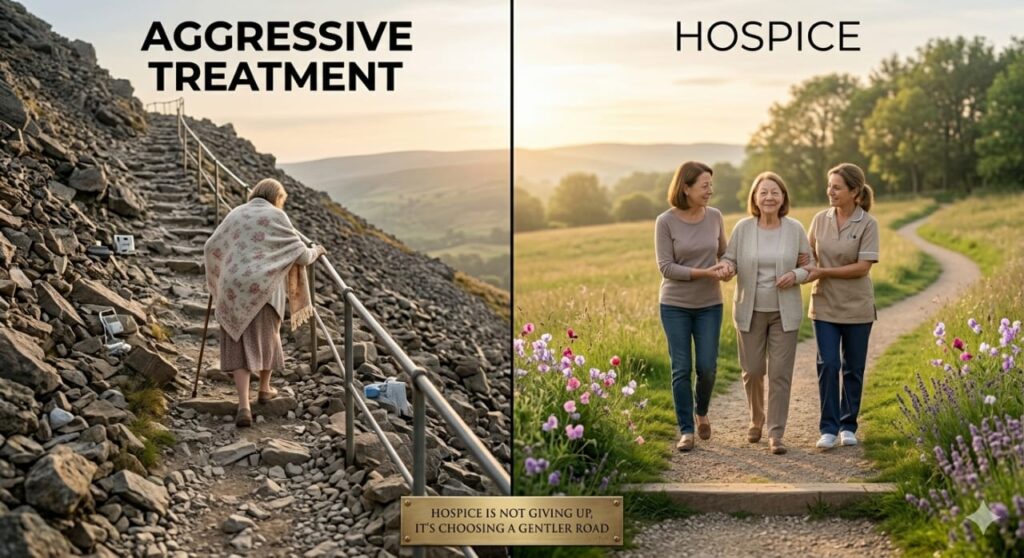
I hadn’t realized how isolated we’d been. Managing her care on our own, navigating crises in the middle of the night, making decisions without anyone to guide us. Hospice wrapped around us like a net, catching what we couldn’t hold alone.
Pain management was the most visible difference. In the hospital, my mother’s pain had been treated reactively; she’d hurt, then they’d medicate. Hospice brought a proactive approach. They kept her comfortable continuously, not just after she suffered. The medications were adjusted based on her specific symptoms, not a one-size-fits-all protocol. She rested better. She smiled again. She wasn’t sedated into oblivion; she was comfortable enough to be present.
That presence was a gift I hadn’t expected. Once her pain was managed, my mother could talk again. Really talk. She told stories I’d never heard. She asked questions I’d been afraid to answer. We said things that needed saying, not dramatic goodbyes, just honest conversations about love, regret, gratitude, and what mattered most. Those weeks were hard, but they were also holy. Without the hospice’s pain management, they wouldn’t have happened.
The emotional support was extended to me, too. I’d been so focused on my mother that I’d neglected myself. The hospice social worker noticed. She checked in on me, asked how I was coping, and normalized the exhaustion and guilt and grief I was carrying. She connected me with a grief support group. She reminded me that I couldn’t pour from an empty cup, that taking care of myself wasn’t selfish, it was necessary.
One of the greatest benefits was symptom management beyond pain. Nausea, shortness of breath, anxiety, constipation, and insomnia, hospice addressed all of it. The nurses had seen everything. They knew which medications worked, which positioning helped, which small comforts made a difference. When my mother couldn’t eat, they didn’t force food; they offered small tastes of whatever sounded good. When she was restless, they adjusted her environment. They treated the whole person, not just the disease.
The equipment was another blessing. A hospital bed was delivered to the house. Oxygen. A wheelchair. Incontinence supplies. All of it arrived within hours of our hospice admission, all of it covered. I hadn’t realized how much of my energy had gone into managing supplies, picking up prescriptions, and figuring out logistics. Hospice handled it, freeing me to just be with my mother.
The twenty-four-hour support line saved me more than once. In the middle of the night, when my mother’s breathing changed, or she became agitated, or I simply panicked, I could call and reach a nurse who knew her case. They’d talk me through what was happening, reassure me it was normal, or come out if needed. I never felt alone, even at 3 AM.
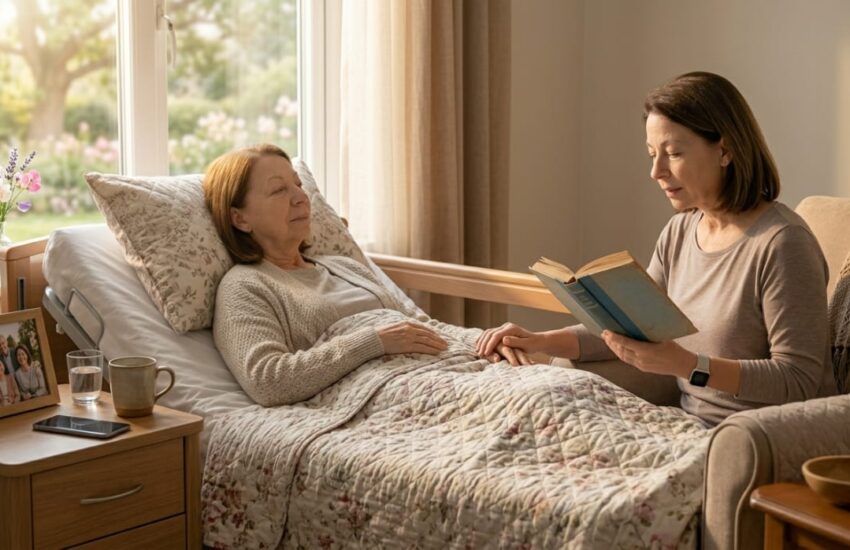
When the end came, hospice made it peaceful. My mother died at home, in her own bed, with me holding her hand. The nurse had prepared us for what to expect: the changes in breathing, the cooling of extremities, the moments of restlessness followed by deep calm. Nothing surprised us. Nothing terrified us. When she stopped breathing, I wasn’t panicked. I was heartbroken, yes, but not frightened. I knew this was the natural conclusion of the process we’d been walking together.
Afterward, hospice continued to support us. Bereavement counseling was available for thirteen months. The social worker called to check in. The chaplain came to the funeral. They didn’t disappear when my mother did. They walked with us through the early grief, that raw and disorienting time when nothing makes sense.
I think often about what I’d feared before hospice. I’d thought it meant abandoning hope. But I was wrong. We didn’t abandon hope; we shifted it. We stopped hoping for a cure that wasn’t coming and started hoping for comfort, connection, peace. Those hopes were fulfilled, again and again, in small moments that added up to a good death.
If you’re considering hospice for a loved one, here’s what I want you to know. Hospice isn’t for people who are giving up. It’s for people who are choosing quality over quantity, comfort over intervention, and presence over procedure. It’s for families who want support navigating one of life’s hardest passages. It’s for anyone facing a terminal diagnosis who doesn’t want to spend their final days in a hospital.
The earlier you start hospice, the more you benefit. Many families wait too long, are afraid of what it means, and miss months of support. My mother was in hospice for six weeks. I wish we’d started sooner. Those weeks were precious, and the hospice team made them possible.
There’s a misconception that hospice speeds death. It doesn’t. Some studies actually show that hospice patients live slightly longer than similar patients who don’t receive hospice care. Better pain management, fewer hospital-acquired infections, less aggressive treatments that weaken the body, hospice supports life, even as it acknowledges that death is coming.
The benefits of hospice care for terminally ill seniors aren’t just about the person dying. They’re about the family living. We carry the memory of those final days for the rest of our lives. Hospice helped make my mother’s final days something I can remember without horror. They were sad, yes. They were hard. But they were also tender, intimate, and full of love. That’s the gift hospice gave us.
If you’re facing this decision, please talk to a hospice provider. Ask questions. Tour a facility if inpatient hospice is an option. Talk to families who’ve used hospice. The fear is real, but the support is real too. You don’t have to walk this path alone.
There’s so much more to learn about end-of-life care options. Our website is filled with articles on hospice, palliative care, advance directives, and supporting loved ones through terminal illness. Head over and explore, because a good death is possible, and hospice can help you find it.
References
Centers for Medicare & Medicaid Services. (n.d.). *Hospice care coverage*. Medicare.gov. https://www.medicare.gov/coverage/hospice-care
National Institute on Aging. (2021, May 13). *What are palliative care and hospice care?* National Institutes of Health. https://www.nia.nih.gov/health/hospice-and-palliative-care/what-are-palliative-care-and-hospice-care
Teno, J. M., Gozalo, P., Mitchell, S. L., Bynum, J., & Mor, V. (2022). Hospice improves care quality for older adults with dementia in nursing homes. *Health Affairs*, *41*(11), 1592–1600. https://pmc.ncbi.nlm.nih.gov/articles/PMC9662595/
U.S. Department of Health and Human Services, Office of Inspector General. (2023, March 27). *Hospice*. https://oig.hhs.gov/reports/featured/hospice/