
 Posted by
State regulations for nursing homes set the rules for staffing, safety, and care quality. Learn how they work alongside federal rules and how to use them to advocate for your loved one.
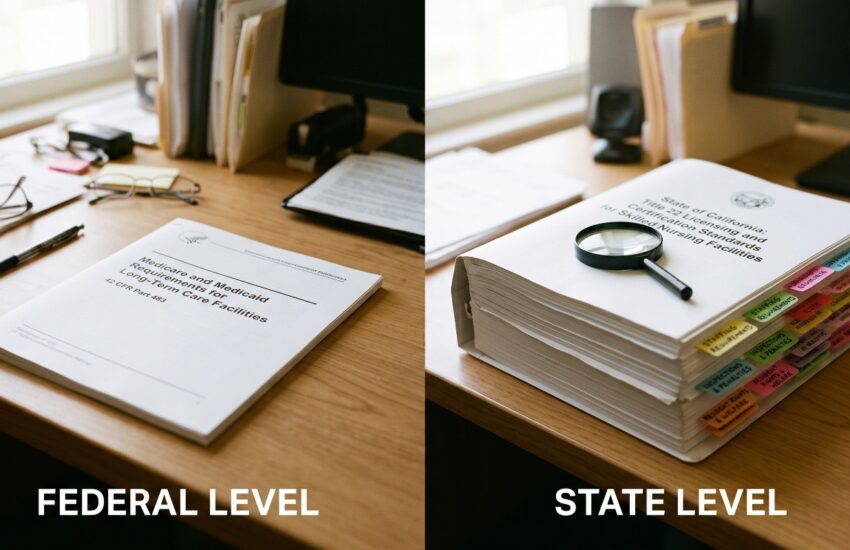
When my mother entered a nursing home, I assumed the federal government was watching. I had heard about Medicare inspections and quality ratings. I thought that was enough. Then a state surveyor walked in unannounced, and I realized there was a whole other layer of oversight I did not understand. The federal rules set a floor. The state rules fill in the details, and sometimes they are the ones that matter most.
State regulations for nursing homes are the laws and rules enacted by each individual state to govern the operation, licensing, and quality of long-term care facilities within its borders. They exist alongside federal requirements, not instead of them. A facility must meet both sets of rules to operate and to receive Medicare and Medicaid funding. But the state rules often go further, adding specifics that federal regulations leave vague.
The most common place to see this is staffing. Federal rules require facilities to have “sufficient” staff to meet resident needs, but they do not define what “sufficient” means. States step in. Florida, for example, requires a minimum of 3.6 hours of direct care per resident per day, with specific ratios for certified nursing assistants and licensed nurses . Minnesota requires 2.0 hours per resident per day . West Virginia sets specific numbers of nursing personnel per shift per resident, filling a gap where federal rules are silent . These numbers are not recommendations. They are legal requirements, and facilities can be cited and fined for failing to meet them.
Licensing and inspection are also state functions. Every state has an agency responsible for licensing nursing homes and conducting inspections. In Virginia, the Department of Health conducts biennial licensure inspections and also performs federal certification surveys on behalf of the federal government . The state agency investigates complaints, responds to immediate jeopardy situations, and ensures compliance with both state and federal regulations . This is the agency you contact when you have a concern that the facility is not resolving.
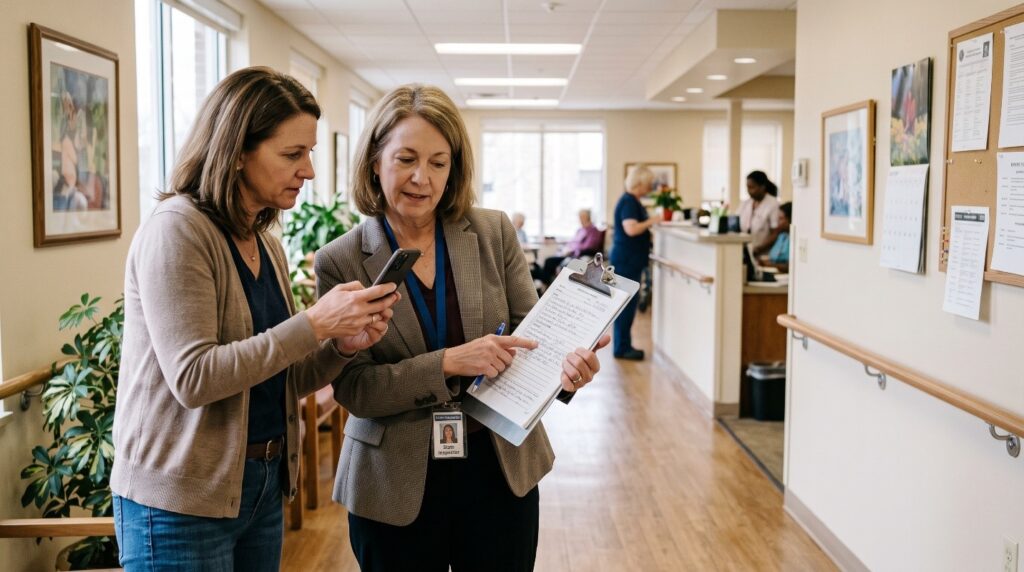
The inspection process varies by state. Some states conduct inspections annually. Others, like Virginia, do them every two years . The rigor of the inspections also varies. A national report found that standard survey coverage ranged from 93.6% of providers in New Hampshire to just 12.1% in Alabama in 2024 . That means in some states, a significant portion of nursing homes are not receiving the standard annual survey that federal rules require. Complaint surveys become even more important in those states, because they are often the only mechanism for identifying problems between standard surveys .
State regulations also address resident rights in greater detail. West Virginia’s state rules provide additional protections beyond federal requirements, including specific rights around retaining personal possessions, practicing religion, participating in care planning, and refusing certain visitors . The state also imposes additional requirements on the activities program director, requiring demonstrated ability to provide ongoing programs and completion of a state-approved training course .
For families, understanding state regulations is a tool for advocacy. When you have a concern about staffing, you can cite the state’s minimum staffing requirements. When you have a concern about care quality, you can request the facility’s most recent state inspection report. These reports are public documents. They list deficiencies, the scope and severity of each, and the facility’s plan of correction. If the facility has a pattern of deficiencies that are not being corrected, you can escalate to the state survey agency.
The state long-term care ombudsman is another resource. Every state has one. Ombudsmen advocate for residents, investigate complaints, and help resolve disputes between families and facilities. They know the state regulations and can help you understand what a facility is required to do.
State regulations are not perfect. Enforcement varies. Some states are more aggressive than others. Some facilities game the system. But the rules exist, and they give families a foundation for holding facilities accountable. They are the details behind the federal floor. And sometimes, the details are where the real protection lives.
If you have a loved one in a nursing home, take the time to learn your state’s specific regulations. Look up the staffing requirements. Find the inspection reports. Know the complaint process. The more you know, the better you can advocate for the care your loved one deserves.
References
1.Centers for Medicare & Medicaid Services. (2026). *Nursing homes: Certification and compliance*. [https://www.cms.gov/medicare/health-safety-standards/certification-compliance/nursing-homes](https://www.cms.gov/medicare/health-safety-standards/certification-compliance/nursing-homes)
2. Medicaid.gov. (n.d.). *Nursing facilities*. [https://www.medicaid.gov/medicaid/long-term-services-supports/institutional-long-term-care/nursing-facilities](https://www.medicaid.gov/medicaid/long-term-services-supports/institutional-long-term-care/nursing-facilities)
3. Centers for Medicare & Medicaid Services. (2024). *Medicare State Operations Manual: Appendix PP—Guidance to surveyors for long-term care facilities*. [https://www.cms.gov/regulations-and-guidance/guidance/manuals/downloads/som107c07pdf.pdf](https://www.cms.gov/regulations-and-guidance/guidance/manuals/downloads/som107c07pdf.pdf)