

 Posted by
 I thought I was being respectful by not bothering the staff. I knew they were busy, and I did not want to be seen as a difficult family member. When I had a concern about my mother’s care, I kept it to myself. I assumed they would notice what I noticed. I assumed they would handle it. I was wrong.
Silence is not respect. Silence is a missed opportunity to share critical information that could improve care, prevent errors, and protect your loved one’s well-being. Communication between family members and nursing home staff is not just helpful. It is essential.
The first lesson I learned was that I knew things the staff did not. I knew my mother’s history, her preferences, and her baseline behavior. I knew when she was acting differently, and I knew what comforted her. The staff had clinical knowledge, but I had personal knowledge. When I started sharing that information, the care improved. Staff learned that she preferred to be called “Mrs. Kim.” They learned that she liked her coffee with two sugars and that she hated being rushed. Those small details made her feel seen and respected.
I also learned that staff often have information that families need. They spend more time with residents than we do. They notice changes in mood, appetite, or mobility that we might miss during a short visit. When I started asking questions, I learned things I had not observed. My mother was having trouble sleeping. She was eating less at lunch. She was becoming withdrawn during evening shifts. That information helped me understand what was happening and advocate for appropriate changes.
Effective communication starts with establishing a relationship. I introduced myself to every staff member who cared for my mother. I learned their names. I thanked them for their work. I asked about their day. When I had a concern, it did not feel like an accusation. It felt like a partnership. They were more willing to listen because they knew I respected them.
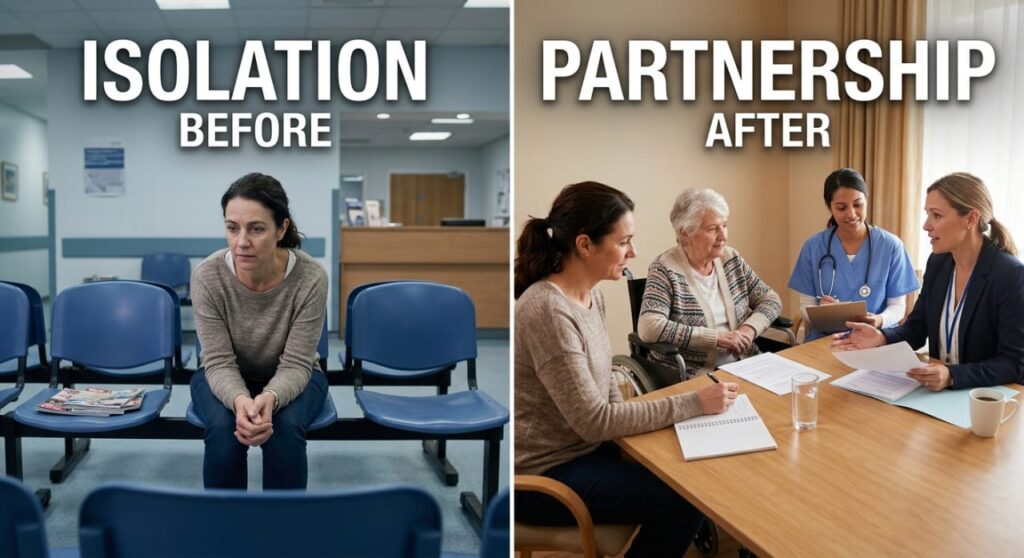
I also learned to communicate concerns in a constructive way. Instead of saying, “You are not feeding my mother properly,” I said, “I noticed Mom is losing weight. Can we talk about her meal plan?” The first approach invites defensiveness. The second invites collaboration. I also learned to focus on the problem, not the person, and to ask open-ended questions.
Documentation was another important tool. When I noticed a pattern of missed call lights or delayed responses, I wrote down the dates and times. That helped me communicate the concern clearly and gave the staff concrete examples to address. I also documented changes in my mother’s condition and shared them with the nursing staff. That helped them adjust her care plan proactively.
One of the most important communication tools is the care plan meeting. Medicare requires these meetings to be held quarterly. They are the best opportunity to review your loved one’s care, set goals, and raise concerns. I attended every meeting and prepared questions in advance. I asked about medications, therapy goals, and discharge planning. I also shared my observations. Those meetings were not just about paperwork. They were about ensuring that the care plan reflected my mother’s needs and preferences.
When a crisis occurred, communication became even more critical. When my mother developed a urinary tract infection, I noticed she was more confused than usual. I called the charge nurse immediately and shared my observation. The nurse assessed her, ordered a urine test, and started antibiotics that same day. That communication prevented a hospital stay. It also reinforced the importance of trusting my instincts and speaking up.
I also learned that communication is not a one-time event. It is an ongoing process. I visited regularly, not just to see my mother but to maintain a presence. I checked in with the nurse at the beginning of each visit. I asked how her night had gone and whether anything had changed. Those brief conversations kept me informed and built trust over time.
Family councils are another powerful communication tool. Many facilities have family councils that meet monthly to discuss concerns and collaborate with administration. I joined the council and found that other families shared similar concerns. Together, we advocated for changes that improved the entire facility.
If you have a loved one in a nursing home, do not wait for a crisis to start communicating. Build relationships early. Share your knowledge. Ask questions. Document concerns. Attend care plan meetings. Join the family council. Your involvement matters, not just for your loved one, but for the quality of care in the whole facility. Communication is the foundation of trust, and trust is the foundation of good care.
There is so much more to learn about advocating for your loved one. Our website is filled with articles on communication, care planning, and family involvement. Head over and explore, because speaking up is not just your right. It is your responsibility.
References
Hovenga, N., et al. (2024). Staff-family communication methods in long-term care homes: A review. *Journal of Long-Term Care*. https://journal.ilpnetwork.org/articles/10.31389/jltc.282
Agency for Healthcare Research and Quality. (n.d.). *Teamwork and communication: Facilitator notes*. https://www.ahrq.gov/hai/quality/tools/cauti-ltc/modules/implementation/long-term-modules/module4/mod4-facguide.html
Gaugler, J. E., et al. (2009). The nature of staff–family interactions in nursing homes: A study of communication patterns and relationships. *The Gerontologist*. https://pmc.ncbi.nlm.nih.gov/articles/PMC2711636/
Gaugler, J. E., et al. (2009). Staff perceptions of staff-family interactions in nursing homes. *Research in Nursing & Health*. https://www.sciencedirect.com/science/article/abs/pii/S0890406508001357
Pillemer, K., Hegeman, C. R., Albright, B., & Henderson, C. (2003). Partners in caregiving: A randomized controlled trial of a cooperative communication intervention for nursing home staff and family members. *The Gerontologist, 43*(Suppl. 2), 96–106. https://academic.oup.com/gerontologist/article/43/suppl_2/96/637549