

 Posted by
 When my parents first mentioned moving to a Continuing Care Retirement Community, I pictured a nursing home. I was wrong. The campus they toured was vibrant, fitness classes, restaurant-style dining, a woodshop, and residents who seemed more like they were on an extended vacation than in their final chapter. They were sold. I was terrified about the cost. But they were thinking about something I hadn’t considered: what happens when independent living is no longer enough.
A Continuing Care Retirement Community, often called a Life Plan Community, is a residential option that offers a full spectrum of care on a single campus . Residents typically start in independent living, their own apartment or cottage, with access to amenities like meals, housekeeping, and social activities . As health needs change, they can transition to assisted living, skilled nursing, or memory care without having to leave the community or uproot their lives . For couples, this is especially valuable because one spouse can remain in independent living while the other receives a higher level of care, and they can still be together on the same campus .
The peace of mind is the biggest selling point. My parents didn’t want me to have to scramble to find them a nursing home in a crisis. A CCRC gives them a plan. Research suggests that older adults in CCRCs live longer, receive more preventive care, and benefit from greater social connection than those who age in place alone . Loneliness is a major health risk, and the built-in community of a CCRC addresses that directly .
But that peace of mind comes with a significant price tag. The financial commitment is steep and complex. Most CCRCs require a large upfront entrance fee, which can range from $100,000 to over $1 million, averaging around $400,000 . This fee doesn’t mean you’re buying the property. It secures your access to future care and may be partially refundable to your estate, depending on the contract . On top of that, residents pay monthly fees, which averaged about $4,200 for independent living as of the end of 2024 . These monthly fees cover housing, meals, maintenance, and amenities. They typically increase annually to cover inflation, often around 4% .
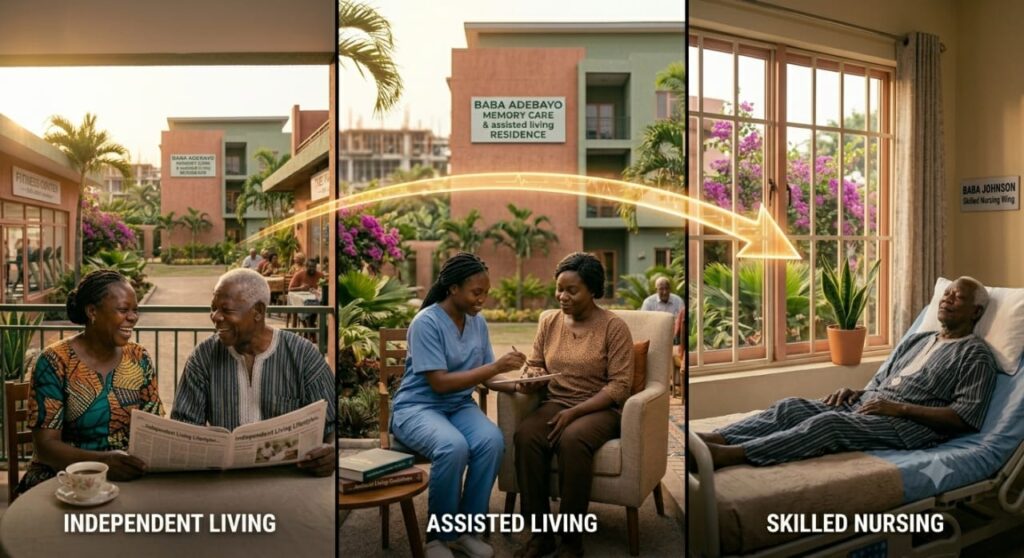
The contract type determines how much of your future care is covered and what happens to your monthly fees if you need a higher level of care . Type A, or Life Care, has the highest entrance and monthly fees, but your monthly costs stay essentially the same even if you move to assisted living or skilled nursing . Type B, or Modified, has lower upfront costs, but your monthly fee will step up to cover the cost of additional care if you need it . Type C, or Fee-for-Service, has the lowest entrance fee, but you pay full market rate for any higher level of care you need .
The financial risk is real. CCRCs have been known to file for bankruptcy, and in such cases, residents can lose their entrance fees and the care they were promised . Before signing any contract, check the facility’s financial health. Look for audited financial statements, ask about occupancy rates (which should be 90% or higher), and review any state-required disclosures . A portion of the entrance fee may be tax-deductible as a prepaid medical expense, so consult a tax professional .
My parents ultimately chose a Type A contract because they valued the predictability. It was a huge investment, but it gave them control over their future. They didn’t want to be a burden. They wanted to be surrounded by friends, activities, and a clear path forward, no matter what health challenges came their way. A CCRC isn’t for everyone, but for my family, it provided something priceless: the reassurance that my parents’ final years would be lived with dignity and that I wouldn’t have to make impossible decisions alone.
There is so much more to learn about senior living and planning for the future. Our website is filled with articles on retirement communities, financial planning, and care options. Head over and explore, because the more you know, the better prepared you’ll be for the road ahead.
References
AARP. (2022, January 26). *Learn about continuing care retirement communities*. https://www.aarp.org/caregiving/basics/continuing-care-retirement-communities/
Harvard Health Publishing. (2024, September 12). *Continuing care retirement communities (CCRCs): What they offer, who might benefit, and what to consider*. https://www.health.harvard.edu/healthy-aging-and-longevity/continuing-care-retirement-communities-ccrcs-what-they-offer-who-migh
Texas Department of Insurance. (2024, October 28). *What to know about continuing care retirement communities*. https://www.tdi.texas.gov/tips/continuing-care-retirement-communities.html
Maryland Department of Aging. (2025, December 30). *Continuing care*. https://aging.maryland.gov/pages/continuing-care-retirement-communities.aspx
California Department of Social Services. (2016, August 14). *Continuing care retirement community*. https://www.cdss.ca.gov/continuing-care-communities