

 Posted by
 The pill organizer looked harmless. Seven days, four compartments per day, color-coded lids. I filled it every Sunday evening, proud of my system. Then my mother was rushed to the hospital with dangerously low blood pressure. The cause was not a new illness or a sudden decline. It was a medication interaction that had been building for weeks. A specialist had added a new prescription, and the pharmacist had not caught the conflict. My system had failed because I did not know what I did not know.
Medication safety is one of the most complex and overlooked aspects of caring for a senior at home. Older adults take more medications than any other age group. They see multiple specialists. They fill prescriptions at different pharmacies. They may have vision problems, memory issues, or difficulty opening bottles. The result is a system ripe for error, and the consequences can be catastrophic. Adverse drug events send hundreds of thousands of seniors to the hospital every year, and many of those visits are entirely preventable.
The first change I made was to consolidate my mother’s care. She was seeing four different doctors who were not communicating with each other. I chose one primary care physician to serve as the quarterback of her care. I asked that all specialists send their notes and medication changes to this one doctor. It took persistence, but eventually, the communication improved, and duplicate prescriptions stopped.
The second change was to use a single pharmacy. My mother had been filling prescriptions at three different places. I moved everything to one independent pharmacy that offered medication therapy management. The pharmacist reviewed her entire regimen, identified two serious interactions, and contacted her doctors to make changes. That single review was more valuable than anything I had done on my own.
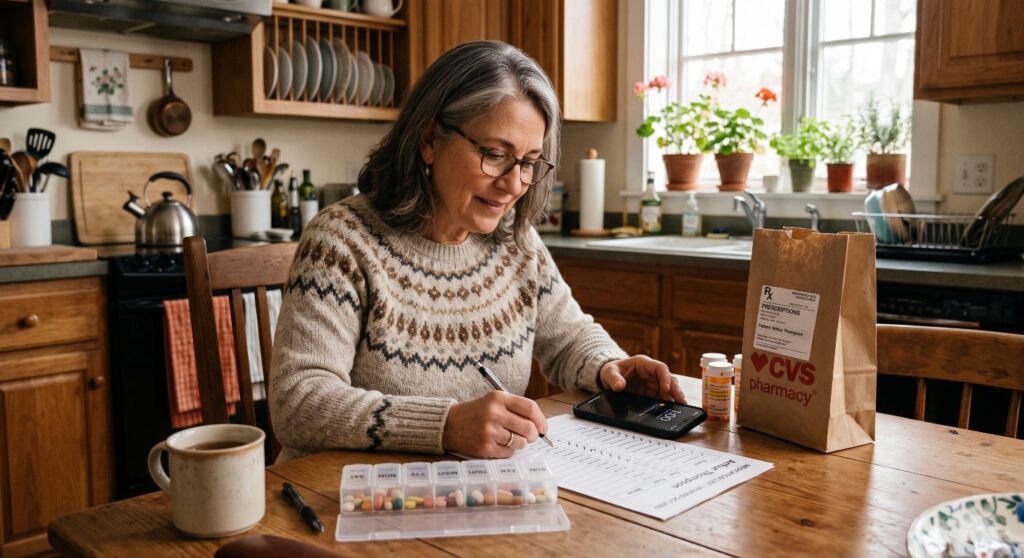
I also learned to keep an updated medication list. I created a simple document that included every prescription, over-the-counter medication, supplement, and vitamin. I listed the dosage, the prescribing doctor, and the reason for each. I kept one copy on the refrigerator, one in my wallet, and one in my mother’s purse. When she went to appointments, she brought the list. When she went to the emergency room, the list went with her. That list prevented several errors.
The medication list became a living document. Every time a doctor made a change, I updated it immediately. I also reviewed it monthly to remove anything that was no longer needed. One of the most eye-opening moments was when I discovered my mother was still taking a medication that had been prescribed for a condition that had resolved years earlier. Her doctor had never told her to stop. We removed it, and her energy improved within weeks.
Simplifying the regimen was another critical step. My mother was taking medications at four different times of day. Some were twice daily, some were once daily, some were every other day. The complexity was overwhelming for her and for me. I worked with her doctor to consolidate the schedule. If a medication could be taken twice daily instead of four times, we made the change. If a medication was no longer essential, we stopped it. The simpler the regimen, the safer it was.
I learned to use the right tools. The standard pill organizer I started with was not enough. I upgraded to a system with alarms and reminders. I also set up automated refills at the pharmacy so we never ran out. I requested easy-open caps for her bottles. For medications she struggled to swallow, I asked the pharmacist about liquid or crushable alternatives. Small adjustments made a big difference.
I also learned to watch for signs of medication problems. Confusion, dizziness, falls, changes in appetite, and sleep disturbances can all be signs of an adverse reaction or an error. When my mother became unusually drowsy one week, I did not assume it was just aging. I reviewed her medications, called her doctor, and discovered that a new prescription was causing the problem. We adjusted the dosage, and her alertness returned.
Perhaps the most important lesson was to involve the pharmacist as a partner. Pharmacists are trained to review medication regimens for interactions, duplications, and inappropriate dosages. They can also recommend cost-saving alternatives and help with insurance issues. I started requesting a consultation every time a new medication was added. It took five minutes, and it caught problems I never would have found.
If you are managing medications for a senior loved one, do not assume the system is working just because no disaster has happened yet. Review the regimen regularly. Consolidate care. Use a single pharmacy. Keep an updated list. Simplify the schedule. Watch for changes in behavior. And ask for help when you need it. Your loved one’s safety depends on it.
There is so much more to learn about protecting seniors at home. Our website is filled with articles on medication management, fall prevention, and caregiver support. Head over and explore, because the right system saves lives.
References
National Institute on Aging. (2022, September 21). *Taking medicines safely as you age*. [https://www.nia.nih.gov/health/medicines-and-medication-management/taking-medicines-safely-you-age](https://www.nia.nih.gov/health/medicines-and-medication-management/taking-medicines-safely-you-age
U.S. Food and Drug Administration. (2026, May 19). *5 medication safety tips for older adults*. [https://www.fda.gov/consumers/consumer-updates/5-medication-safety-tips-older-adults](https://www.fda.gov/consumers/consumer-updates/5-medication-safety-tips-older-adults)
Alzheimer’s Association. (n.d.). *Medication safety*. [https://www.alz.org/help-support/caregiving/safety/medication-safety](https://www.alz.org/help-support/caregiving/safety/medication-safety)
Family Caregiver Alliance. (2013, July 16). *Caregiver’s guide to medications and aging*. [https://www.caregiver.org/resource/caregiver%CA%BCs-guide-medications-and-aging/](https://www.caregiver.org/resource/caregiver%CA%BCs-guide-medications-and-aging/)
AARP. (2020, October 21). *Family caregiver’s guide to medication management*. [https://www.aarp.org/caregiving/medical/medication-management/](https://www.aarp.org/caregiving/medical/medication-management/)
Caregiver Action Network. (2024, June 5). *Medication management guide for family caregivers*. [https://www.caregiveraction.org/medication-management-for-family-caregivers/](https://www.caregiveraction.org/medication-management-for-family-caregivers/)
U.S. Department of Veterans Affairs. (2017, June 21). *Medication safety*. [https://www.dementia.cindrr.research.va.gov/caregiver_topics/safety/medication_safety.asp](https://www.dementia.cindrr.research.va.gov/caregiver_topics/safety/medication_safety.asp)