

 Posted by
 When my mother’s dementia reached the point where she wandered from home at night and became confused about basic tasks, I realized I could no longer keep her safe on my own. The decision to move her into a memory care facility was one of the hardest I have ever made. I felt like I was giving up. Instead, I was giving her the best chance at safety, dignity, and quality of life.
Memory care facilities are specialized long-term care residences designed specifically for people living with Alzheimer’s disease or other forms of dementia . Unlike assisted living, which focuses on helping seniors maintain independence while managing daily tasks, memory care is built around the unique needs of cognitive decline . The physical layout, staffing ratios, and daily programming are all designed around how the condition progresses .
The first and most immediate benefit I noticed was safety. People with dementia often wander, and wandering can be life-threatening . Memory care facilities are designed with secured entrances, alarmed doors, and enclosed outdoor areas where residents can move freely without the risk of getting lost . My mother’s facility had a beautiful secure garden where she could walk safely. I no longer woke up in the middle of the night terrified that she had left the house.
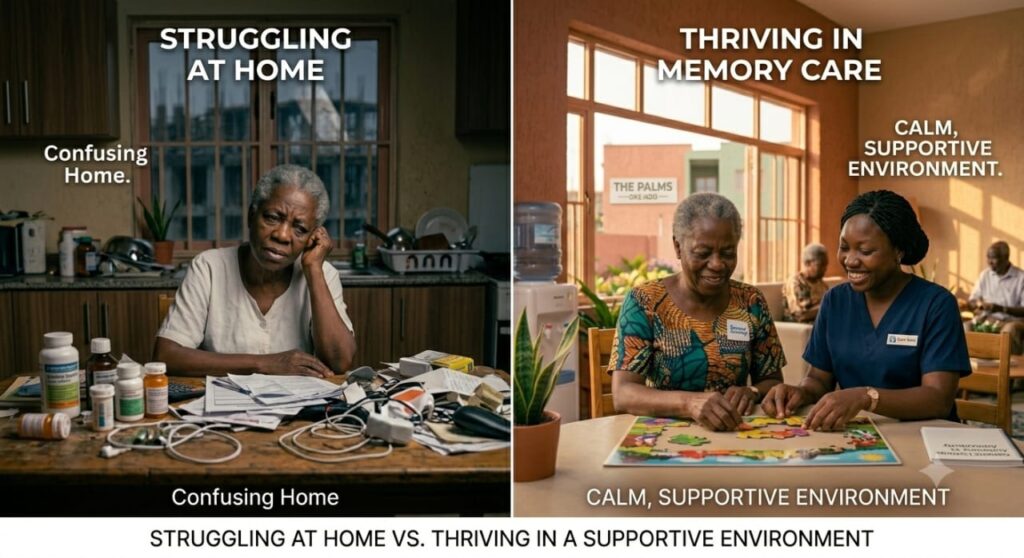
The staff made all the difference. Memory care staff receive specialized training in dementia care that goes far beyond what is required in assisted living . They understand how to communicate with someone whose verbal abilities are declining. They know how to redirect agitation and calm anxiety without confrontation. They recognize that behaviors we might see as problems are actually expressions of unmet needs . My mother’s caregivers did not argue with her confusion. They validated her feelings and gently guided her through the day.
One of the most surprising benefits was the structured routine. People with dementia often feel disoriented and anxious because they lose track of time and place . Memory care facilities provide a consistent daily schedule, meals, activities, and rest at predictable times. That predictability reduces stress and gives residents a sense of security. My mother thrived on the rhythm of the day. She knew when meals would come, when activities would happen, and when she could rest.
The activities themselves were designed for people with dementia. Reminiscence therapy, music therapy, art, and sensory engagement are all evidence-based approaches that stimulate remaining cognitive abilities and bring joy . My mother could not follow a complex conversation anymore, but she could hum along to old songs and sort through fabric swatches. Those moments of connection were priceless. Meaningful engagement is not just about filling time. It is about preserving identity and dignity .
I also learned that memory care facilities offer flexibility that home care often cannot. Some facilities provide a full continuum of care, allowing residents to transition from early-stage support to more intensive care as their needs change . That continuity prevents the trauma of multiple moves. My mother spent her final years in the same facility, with the same familiar faces, even as her needs increased.
The decision to move my mother into memory care did not mean I stopped being her advocate. It meant I could return to being her daughter instead of her primary caregiver . I could visit her, hold her hand, and share moments of connection without the exhaustion of constant supervision. That shift was essential for both of us.
Memory care is expensive, with average costs ranging from $6,500 to nearly $8,000 per month depending on location and level of care . Most families pay out of pocket, though long-term care insurance, Medicaid, and veterans’ benefits may offer some support . The cost is significant, but I learned that quality memory care is an investment in safety, dignity, and quality of life that cannot be measured in dollars alone.
Choosing memory care does not mean giving up on your loved one. It means choosing a setting where they can be safe, engaged, and treated with the specialized care they deserve. It means letting go of the guilt and trusting trained professionals who understand what your loved one needs. For my mother, and for me, it was the right choice.
There is so much more to learn about dementia care options. Our website is filled with articles on memory care, transitioning a loved one, and finding the right facility. Head over and explore, because the right care starts with the right information.
References
Alzheimers.net. (2024, July 1). *Top 10 benefits of memory care*. [1]
A Place for Mom. (2024, October 8). *Memory care: A senior living option for those with dementia or Alzheimer’s*. [2]
Cleveland Clinic. (2024, March 25). *Memory care: Specialized support for people with Alzheimer’s or dementia*. [3]
Cornell, P. Y., et al. (2022, January 2). *Memory care reduces nursing home admissions among assisted-living residents*. [4]
Senior Lifestyle. (2024, August 27). *The impact of memory care services for seniors*.