
 Posted by
 When my father moved into a nursing home, I thought the nurses would be his primary caregivers. Then I met the social worker, and I realized she was the invisible thread holding everything, and everyone, together. Here’s what I learned about the unsung heroes of long-term care.
The day we moved my father into the nursing home, I was a wreck of competing emotions. Guilt, because I couldn’t care for him at home anymore. Relief, because his dementia had reached a point where I physically couldn’t keep him safe. Hope, because the facility seemed warm and the staff seemed kind. And fear, a deep, gnawing fear that he would be lost in the system, a quiet man in a quiet room, invisible to everyone except the aides who cleaned and fed him.
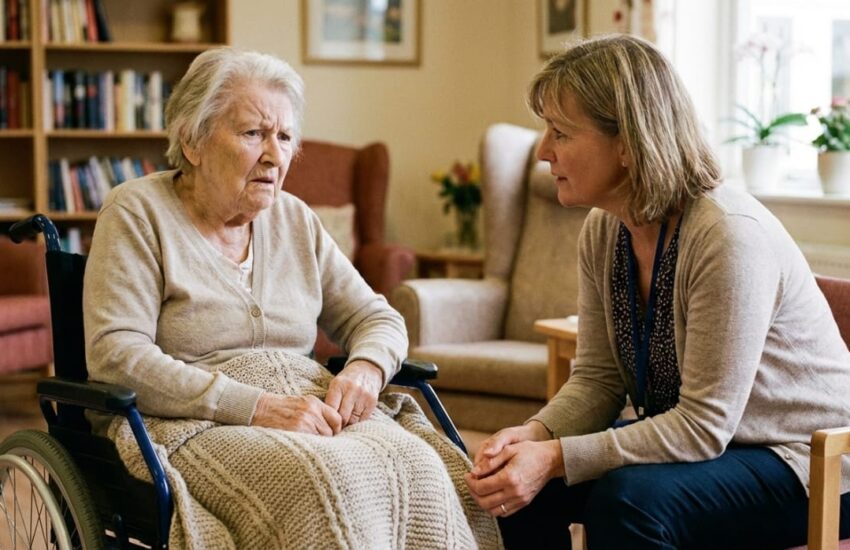
I shook hands with the nurses. I thanked the administrative staff. I smiled at the activities director. And then a woman named Ellen appeared in the doorway of his new room, carrying a clipboard and wearing the softest expression I had seen in weeks.
“I’m the social worker here,” she said. “I’m not here to manage his medications or his meals. I’m here to manage everything else. I’m here for him, and I’m here for you.”
I didn’t know it then, but that introduction was the beginning of my education. Over the next three years, I watched Ellen operate from the margins, never quite center stage but absolutely essential to every scene. She was the thread that wove through my father’s care, the translator between medical language and family emotion, the advocate who showed up when no one else could.
Let me tell you what social workers in nursing homes actually do, because I had no idea until I needed one.
The first thing I learned was that Ellen handled the admission like a diplomat navigating a peace treaty. My father arrived with a mountain of paperwork, medical records, advance directives, insurance forms, medication lists, and power of attorney documents.
It was overwhelming, a blizzard of paper that seemed designed to confuse grieving families. Ellen sat with me for two hours, going through every page, explaining what each one meant, making sure I understood what I was signing. She didn’t rush. She didn’t make me feel stupid for asking questions. She just patiently translated the bureaucracy into plain English.
That was her first gift to me: making the incomprehensible comprehensible.
Then came the hard part. My father, in his confusion, was angry. He didn’t understand why he was in this strange place with strange people. He lashed out at the aides. He refused to eat. He tried to walk out the door, convinced he needed to go home to his mother, who had been dead for forty years. The nurses could handle his medications, but they couldn’t handle his despair. That’s where Ellen stepped in.
She didn’t try to reason with him, because you can’t reason with dementia. Instead, she sat with him. She listened to his stories about his mother, about the farm, about a childhood he remembered more clearly than breakfast. She validated his feelings without arguing with his reality. She taught the aides how to redirect him without confrontation, how to enter his world instead of forcing him into theirs. She was the emotional interpreter, translating his fear into language the rest of the staff could understand and respond to.
But Ellen’s role wasn’t just about my father. It was about me, too. In those early weeks, I called her constantly. Is he eating? Why won’t he take his medication? What do I do when he cries on the phone? She answered every call with the same patient calm, never making me feel like a burden. She connected me with a support group for adult children of dementia patients. She helped me navigate the maze of Medicare and Medicaid when his savings started running low. She reminded me, again and again, that I wasn’t abandoning him, that placing him in the nursing home was an act of love, not failure.
Social workers in nursing homes are family therapists, whether they’re trained for it or not. They hold the hands of daughters like me who are drowning in guilt. They sit with sons who can’t look at their fathers hooked to oxygen. They absorb the anger of spouses who visit every day and watch their life partners fade by inches. They do this without fanfare, without recognition, often without anyone understanding the emotional weight they carry.
Then there were the family meetings. Oh, those meetings. When my father developed a swallowing problem and the speech therapist recommended a feeding tube, the room filled with experts. The nurse had data. The dietitian had charts. The doctor had opinions. And Ellen sat quietly, watching me, watching my siblings, watching the tension build in our shoulders. When the discussion became too clinical, too focused on protocols instead of person, she gently interjected.
“Before we decide,” she said, “I’d like to hear what the family thinks Dad would have wanted.”
She was the only person in that room who remembered that my father wasn’t just a patient with a swallowing disorder. He was a man who loved fishing, who hated hospitals, who once told me he never wanted to be kept alive by machines. Ellen made sure that voice his voice was heard, even though he could no longer speak it himself.
This is the invisible work of social workers. They don’t just coordinate care; they coordinate humanity. They ensure that the person at the center of all these medical decisions doesn’t get lost in the machinery. They ask the questions no one else thinks to ask. They hold the space for grief, for anger, for the messy, complicated emotions that come with watching someone you love decline.
When conflicts arose between staff and family, Ellen was the mediator. When a certified nursing assistant seemed rough with my father, I went to Ellen first. She didn’t dismiss my concern, but she also didn’t rush to judgment. She observed, she gathered information, she facilitated a conversation that addressed my fears without destroying the caregiver’s morale. She protected my father, but she also protected the team that cared for him, understanding that burnout and resentment ultimately hurt residents most.
And when the end came, Ellen was there. She helped us understand the signs, prepared us for what to expect, made sure my father was comfortable and pain-free. She sat with us in the waiting room while we said our goodbyes. She came to the funeral. She sent a card. She checked on me months later, long after her official duties had ended, just to ask how I was doing.
I think about Ellen often. I think about how she did her job with almost no recognition, how she absorbed the pain of dozens of families while managing the administrative chaos of a complex institution. I think about the social workers in every nursing home, working in the shadows, holding the emotional weight that no one else can carry.
Here’s what I want you to know: when you place a loved one in a nursing home, the social worker is your ally. They are not just staff; they are your guide through a system that can feel cold and impersonal. They are the ones who remember birthdays, who notice when a resident seems withdrawn, who advocate for dignity when the medical machine wants efficiency. They are the bridge between clinical care and human experience, and without them, the whole structure crumbles.
So if you have a loved one in long-term care, find the social worker. Introduce yourself. Ask for their help. Let them hold some of the weight you’re carrying. They are trained for it, yes, but more than that, they chose this work because they believe that even at the end of life, even in the midst of decline, every person deserves to be seen, heard, and valued.
My father was lucky. He had Ellen. And in a way, so was I.
References
Nurse Skills Hub. (2025, March 3). *Unveiling the role of social workers in nursing homes*. Retrieved from https://nurseskillshub.com/blog/social-workers-nursing-homes/
Nursing Home 411. (2024). *The crucial role of social workers in nursing homes* [Fact Sheet]. Retrieved from https://nursinghome411.org/wp-content/uploads/2024/06/Fact-Sheet-Social-Work-Staff.pdf
Kissito Healthcare. (2023, March 19). *Exploring the roles of social workers in SNFs*. Retrieved from https://kissito.org/exploring-the-roles-of-social-workers-in-snfs/
International Federation of Social Workers. (2020, May 31). *The liaison social work role in nursing homes and residential settings: A model for practice*. Retrieved from https://www.ifsw.org/the-liaison-social-work-role-in-nursing-homes-and-residential-settings-a-model-for-practice/
Missouri Department of Health and Senior Services. (n.d.). *The role of the social worker in the long-term care facility*. Retrieved from https://health.mo.gov/seniors/ombudsman/pdf/RoleLTCsocialworker.pdf