
 Posted by
 My father was always a talker. Not in an overwhelming way, but in the way of someone who genuinely loved conversation. He told stories at dinner, asked questions about everyone’s lives, and had a running commentary on whatever sports game happened to be on television. His voice was part of who he was, warm, engaged, endlessly interested in the world and the people around him.
When the stroke took his words, it took more than speech. It took his ability to tell stories, to ask about my day, to argue about politics, to say “I love you” without assistance. For weeks after, he lay in his nursing home bed, eyes open but increasingly withdrawn, trapped inside a head that could form thoughts but couldn’t release them. The staff was kind, but they had limited time and limited tools. They brought him food, changed his sheets, and turned him to prevent bedsores. They couldn’t give him back his voice.
That’s when a speech-language pathologist named Rachel entered our lives. And through her, I learned the profound role of speech-language pathologists in supporting communication skills in nursing homes, work that is about far more than words.
Let me start with what speech-language pathologists actually do, because most people, including me before I needed one, have no idea. They’re not just for children who lisp or adults who stutter. In nursing homes, SLPs are essential members of the care team, working with residents who have communication disorders from stroke, dementia, Parkinson’s, brain injury, or simply the aging process itself.
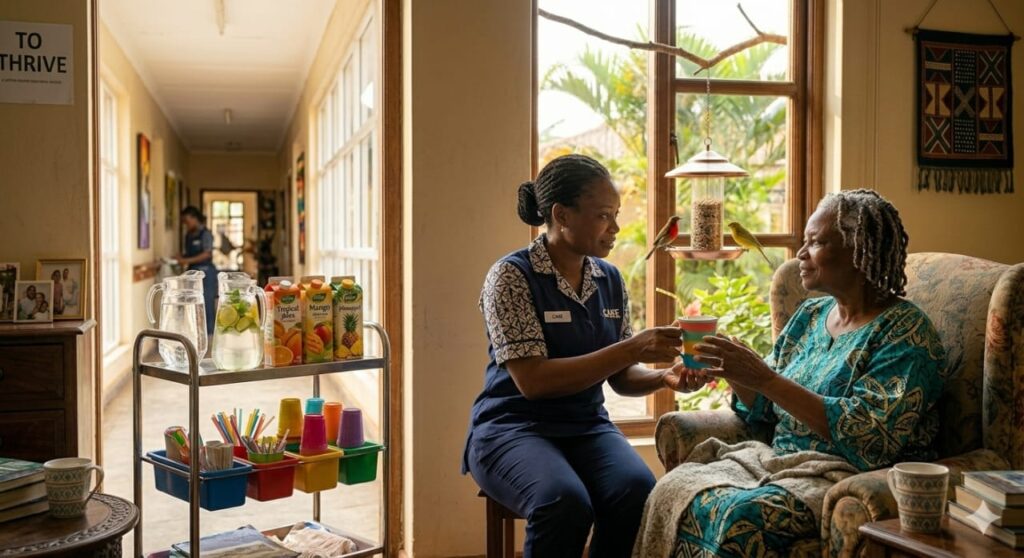
For my father, Rachel began with an assessment. She spent time watching him, trying to understand what he could still do and where he was stuck. Could he understand language even if he couldn’t produce it? Could he gesture? Could he write? Could he use a communication device? The answers to these questions would shape everything else.
She discovered that his comprehension was largely intact. He understood what people said to him. The problem was expression, getting words from the brain to the mouth. This is aphasia, and it’s devastating because you’re fully aware, fully present, but locked out of conversation. Rachel explained that my father wasn’t confused or withdrawn by choice. He was withdrawing because interaction had become too frustrating, too humiliating.
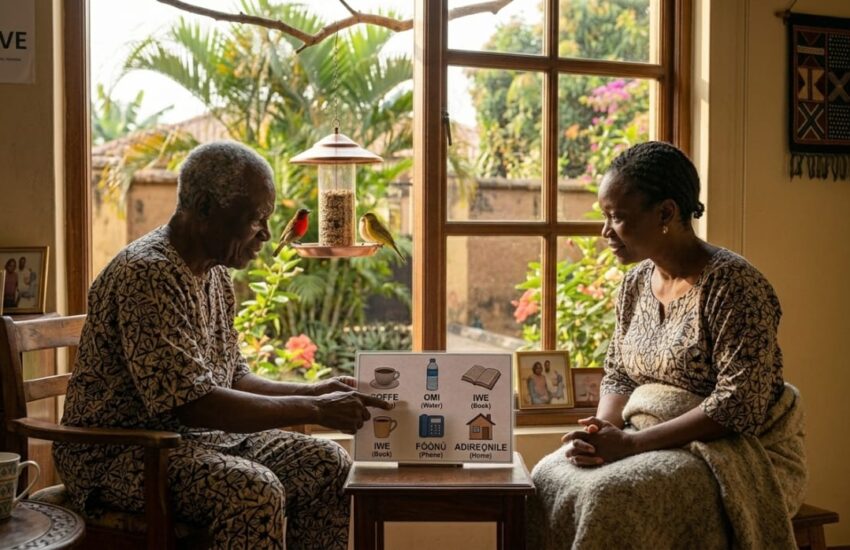
The first thing Rachel did was give him tools. She introduced a communication board, a simple laminated page with pictures of common needs and feelings. Water. Bathroom. Pain. TV. Tired. Happy. Sad. He could point, and suddenly he could communicate basic needs without the exhausting struggle for words. The relief on his face the first time he pointed to “pain” and a nurse responded immediately, I’ll never forget it. He’d been suffering in silence, and no one knew because he couldn’t tell them.
For residents with more advanced needs, SLPs use more sophisticated tools. Speech-generating devices, tablet apps, and eye-gaze technology for those who can’t move anything but their eyes. The role of speech-language pathologists in supporting communication skills includes matching each resident with the right technology and teaching them and their families how to use it.
But technology isn’t always the answer. Rachel also worked on what she called “communication strategies”, ways for my father to participate in conversation despite his limitations. She taught us to ask yes-or-no questions instead of open-ended ones. To give him extra time to respond without jumping in to finish his sentences. To watch his face and hands for communication that wasn’t verbal. To include him in conversations even when he couldn’t contribute much, because being included matters even when you’re silent.
She also worked on his swallowing, which is another critical part of speech-language pathology. The same muscles that produce speech also manage swallowing, and many nursing home residents have difficulty with both. Rachel assessed his swallowing safety, recommended texture modifications to his food, and taught staff how to position him during meals to reduce aspiration risk. She literally kept him from choking to death while also trying to give him back his voice.
For residents with dementia, the work is different but equally important. As language declines, SLPs train staff and families in how to communicate effectively, using simple sentences, speaking slowly, allowing time for processing, using visual cues, and avoiding arguments about reality. They help create communication passports that tell staff about the resident’s history, preferences, and personality, so interactions can be personalized even when the resident can’t advocate for themselves.
For residents who are non-verbal, SLPs focus on alternative communication. Gesture systems, picture boards, simple signs. They teach staff to look for communication in behavior, agitation that means pain, withdrawal that means depression, and restlessness that means boredom. They reframe “problem behaviors” as communication attempts, which changes how staff respond.
Rachel also worked with us, the family. She taught us how to visit in ways that reduced frustration and increased connection. Bring photos, she suggested. Talk about old memories instead of asking questions about the present. Read aloud from a favorite book. Sing songs from his youth. These weren’t just activities; they were communication, ways of staying connected when words failed.
The most profound lesson I learned from Rachel was that communication is not the same as speech. My father could lose his words, but still communicate. His eyes still lit up when I walked in. His hand still squeezed mine. His face still showed pleasure at a familiar song. These were communications, too, and paying attention to them kept us connected even when conversation was impossible.
After months of work, my father regained a few words. Not many, not consistently, but enough. “Hi.” “Good.” Your name, sometimes. Each one was a gift. And when he couldn’t find the words, he had his board, his gestures, his family who had learned to read his face. He wasn’t the talker he’d been before, but he wasn’t silent either. He could still be in a relationship, still be known, still be loved.
The role of speech-language pathologists in supporting communication skills in nursing homes is often invisible to families. We see the nurses who bathe and medicate. We see the aides who bring meals. We may not see the SLP who spends an hour teaching a resident to use a communication board, training staff in dementia communication strategies, or assessing swallowing safety. But that work is foundational. Without it, residents disappear into silence, cut off from connection, isolated even in a crowded room.
If you have a loved one in a nursing home who’s struggling with communication, ask about speech-language pathology. Ask for an assessment. Ask what tools and strategies might help. Ask how you can communicate more effectively. The answers could transform your visits and your relationship.
My father died four years after his stroke. In his final weeks, he couldn’t speak at all. But he could still squeeze my hand when I said: “I love you.” He could still smile at a familiar song. He could still make his eyes meet mine. Those weren’t words, but they were him. And because of Rachel’s work, because of everything she taught us about communication beyond speech, I could still hear him.
There’s so much more to learn about supporting our elders through the challenges of aging, and our website is filled with resources on communication, dementia care, and family advocacy. Head over and explore, because connection matters until the very end.
References
Hilari, K., & Barrett, B. (2015). Communication skills training in a nursing home: Effects of a brief intervention led by nursing home staff. *International Psychogeriatrics*, *27*(1), 147–156. https://doi.org/10.1017/S1041610214001449
Garrett, K., & Beukelman, D. R. (2014). Role of the speech-language pathologist: Augmentative and alternative communication for acute care patients with severe communication impairments. *AAC: Augmentative & Alternative Communication*, *31*(1), 4–15. https://doi.org/10.3109/07434618.2014.1001527
McCormick, L. M., & Ward, E. C. (2024). Interprofessional collaboration among speech-language pathologists and nurses in acute care. *Pakistan Journal of Medical Sciences*, *37*(2), 1–6. https://pmc.ncbi.nlm.nih.gov/articles/PMC7931301/
Walmsley, B., & McComas, J. (1983). Speech-language pathology services in a skilled nursing facility. *Journal of Communication Disorders*, *16*(4), 263–272. https://doi.org/10.1016/0021-9924(83)90026-X