
 Posted by
 The first time I saw it happen, I didn’t fully understand what I was witnessing. My neighbor Margaret, a retired schoolteacher with arthritis so severe she could barely hold a cup, sat slumped in her wheelchair by the nursing home window. Her face was a map of discomfort, the kind of chronic pain that doesn’t shout but settles deep into bones and stays. The staff had tried medications, heat packs, gentle exercises. Nothing seemed to reach her.
Then a volunteer arrived with a guitar. She sat in the corner of the common room and started playing old folk songs, the kind Margaret would have grown up with. At first, nothing changed. But then, slowly, almost imperceptibly, Margaret began to hum. Her shoulders dropped. Her fingers, gnarled and swollen, tapped against the armrest. By the third song, she was singing along, her voice creaky but present. And for the first time in weeks, she wasn’t reaching for the call button.
That moment stayed with me. It was my first real glimpse into the role of music in pain management in nursing homes, a field I would later learn is backed by decades of research, yet remains one of the most underutilized tools in long-term care.
Let me be clear: music isn’t a replacement for modern medicine. It won’t heal a broken bone or stop the progression of a disease. But what it can do, what I watched it do for Margaret and countless others, is transform the *experience* of pain. And for people living in nursing homes, where pain is often chronic and options are limited, that transformation is nothing short of revolutionary.
The science behind this is fascinating. When we listen to music we enjoy, our brains release dopamine, the same neurotransmitter involved in pleasure and reward. But more importantly for pain management, music also triggers the release of endorphins, the body’s natural painkillers. It’s the same mechanism that gives runners that famous “high,” but accessible to someone who can’t even walk to the bathroom without assistance.
Beyond the chemistry, music works on pain through distraction and focus. Pain demands attention. It insists on being the center of your awareness, crowding out everything else. But music, especially familiar and beloved music, competes for that attention. It gives the brain something else to hold onto.
I’ve seen residents undergo uncomfortable wound care while listening to headphones, their faces calm, their bodies relaxed, because their minds were elsewhere, in a memory, a melody, a moment that wasn’t about the pain.
For residents with dementia, the effect is even more pronounced. The parts of the brain that process music are often among the last to be affected by the disease. A person who can’t recognize their own daughter may still be able to sing along to “You Are My Sunshine” word for word.
That connection isn’t just emotional; it’s physiological. Music can lower heart rate, reduce blood pressure, and decrease levels of cortisol, the stress hormone that amplifies pain. In a population where verbal communication is often compromised, music becomes a bridge, a way to reach someone who has otherwise retreated behind the walls of their own mind.
I spoke with a music therapist at a facility I visited, a woman named Diane who had been doing this work for over twenty years. She told me about a resident named George, a former jazz musician with advanced Parkinson’s disease. George’s tremors were severe, his mobility limited, and his pain constant. He rarely spoke and spent most days staring at the ceiling. Diane started visiting him weekly, bringing recordings of old jazz standards.
At first, nothing. But then one day, during “Misty,” George’s foot began to tap. Not a tremor, a deliberate, rhythmic tap. Then his fingers moved, playing an invisible piano in the air above his chest. He couldn’t speak, but he could play. And while he played, Diane said, his face lost its tension. His breathing slowed. For those thirty minutes, he wasn’t a patient in pain. He was a musician, lost in the music he loved.
That’s the heart of what music offers in pain management: not just symptom relief, but identity preservation. In nursing homes, it’s easy to become defined by what’s wrong with you, your diagnosis, your limitations, your pain. Music reminds you of who you were before all of that. It reconnects you to yourself.
Implementing music programs in nursing homes doesn’t require a concert hall or professional musicians, though both are wonderful. It starts simpler than that. It starts with knowing the residents. What songs did they dance to at their wedding?
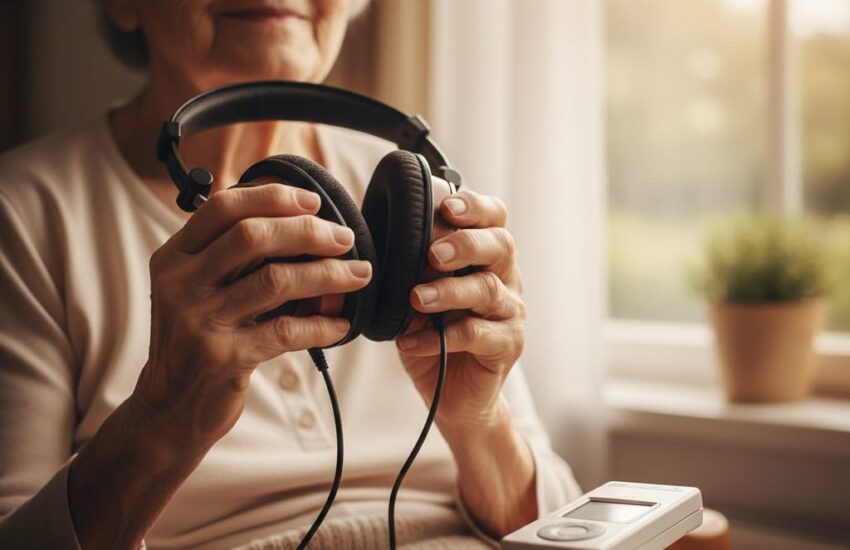
What lullabies did they sing to their children? What radio station played in their first car? Personalized playlists, loaded onto simple devices, can give residents access to “their” music whenever they need it. Some facilities have started using headphones during difficult moments, bathing, wound care, physical therapy, with remarkable results.
Group sing-alongs bring the additional benefit of social connection, which itself reduces pain by combating the isolation that makes suffering worse. Even ambient music in common areas can shift the entire atmosphere of a facility, creating calm where there was once tension, easing the collective anxiety that spreads among residents and staff alike.
The staff benefit, too. Nursing home work is physically and emotionally demanding. Caregivers experience their own stress, their own pain. Music in the workplace has been shown to reduce burnout, improve mood, and increase patience, all of which trickle down to residents. When the whole environment softens, everyone feels it.
I think about Margaret often, about that first moment I saw her come alive through song. She passed away two years later, but until the end, music remained her companion. Her daughter told me that in her final weeks, they played her favorite hymns continuously. She couldn’t speak, couldn’t open her eyes, but her lips moved with the words. The pain didn’t disappear, but it was joined by something else, something that made it bearable.
If you’re caring for someone in a nursing home or simply want to learn more about innovative approaches to senior care, we’ve gathered plenty of resources on our website that explore these topics in greater depth. From music therapy to memory care to family advocacy, there’s always something new to discover that can make a real difference in the lives of those we love.
References
Mamo, S. K., et al. (2019). *Positive physical and mental outcomes for residents in nursing homes participating in a music-based activity program: A cluster randomized controlled feasibility study*. *Journal of Music Therapy, 56*(1), 32–60. https://doi.org/10.1093/jmt/thy021
Wróbel, A., et al. (2024). *The effects of individual music therapy in nursing home residents with dementia: A randomized controlled trial*. *Nursing Reports, 14*(1), 725–737. https://doi.org/10.3390/nursrep14010055
Bradt, J., et al. (2015). *“Where’s the music?” Using music therapy for pain management*. *American Journal of Hospice and Palliative Medicine, 32*(8), 847–852. https://doi.org/10.1177/1049909114546637
Cepeda, M. S., et al. (2013). *Music therapy reduces pain in palliative care patients: A randomized controlled trial*. *Journal of Pain and Symptom Management, 45*(5), 822–839. https://doi.org/10.1016/j.jpainsymman.2012.05.011
Jespersen, K. V., et al. (2022). *The effect of music interventions on chronic pain experienced by older adults: A systematic review*. *Pain Management Nursing, 23*(2), 182–191. https://doi.org/10.1016/j.pmn.2021.11.004