
 Posted by
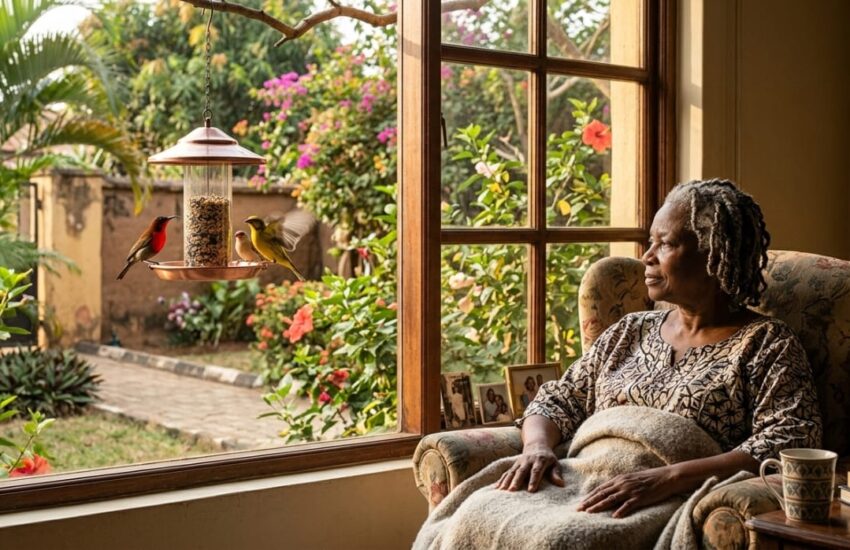
 My mother spent her first three months in the nursing home, refusing to leave her room. She sat by the window, staring out at the parking lot, watching cars come and go, but never participating in anything. The activities staff tried everything, bingo, music, and a baking class. She declined it all.
The only thing that caught her attention, briefly, was the small bird feeder mounted outside the dining room window. She’d watch the sparrows argue over seeds, and for a few minutes, her face would soften. When the facility announced it was building a secure garden, I was skeptical. It sounded like another well-intentioned project that would end up underused and overgrown.
But I didn’t know then what I know now about incorporating nature and outdoor spaces in nursing home design, and how profoundly the right environment can transform lives. The garden opened in June. My mother agreed, reluctantly, to be pushed outside “just for five minutes.” She sat in the shade, facing a bed of lavender and rosemary.
The scent drifted toward her. A butterfly landed nearby. She closed her eyes and took a breath so deep I could see her shoulders drop. Those five minutes became twenty, then an hour, then a daily ritual. She started asking to go out. She started talking, not much, but more than she had in months. The garden didn’t cure her dementia, but it woke something that had been sleeping.
What I learned, through watching my mother and talking to the designers who created that space, is that incorporating nature and outdoor spaces in nursing home design isn’t an amenity. It’s a medical intervention. It’s as essential as medication, as important as therapy, as fundamental as nutrition.
Let me start with the science, because it’s remarkable. Exposure to nature reduces cortisol, the stress hormone. It lowers blood pressure and heart rate. It improves sleep by supporting circadian rhythms. It reduces agitation and aggression in people with dementia. It even reduces pain perception; patients who can see trees from their windows request fewer pain medications than those who see only walls.
For nursing home residents, who often spend their days indoors under artificial light, disconnected from the rhythms of the natural world, this isn’t just nice to have. It’s necessary.
But not just any outdoor space works. Incorporating nature and outdoor spaces in nursing home design requires thought, intention, and a deep understanding of the residents who will use them. The first principle is accessibility. A garden that residents can’t easily reach might as well not exist. Paths need to be wide enough for wheelchairs and walkers, smooth enough to navigate safely, and with gentle slopes instead of steps.
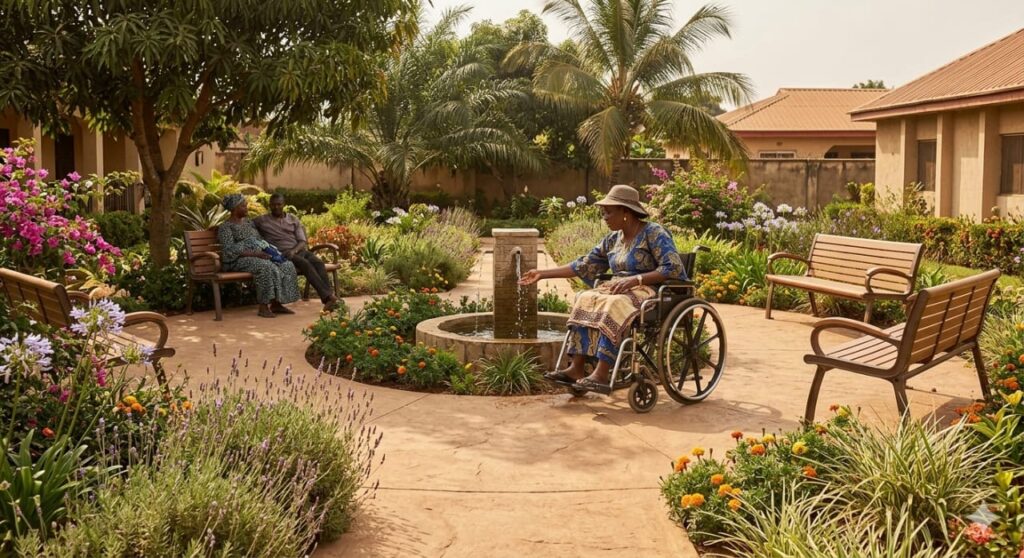
My mother’s garden had circular paths that looped back to the starting point, no dead ends, no confusing turns, no risk of getting lost. Residents could wander independently, following the path as far as they wanted, always able to find their way back.
Seating matters enormously. Not just benches, but varied seating at different heights and with different supports. Some residents need armrests to push themselves up. Some need backs. Some prefer shade, others sun. My mother’s garden had a mix, wooden benches under arbors, chairs with cushions in sunny spots, even a swing seat wide enough for two, where families could sit together.
Sensory engagement is the heart of therapeutic garden design. For residents with dementia, who may have lost cognitive abilities but retain sensory awareness, the garden should engage every sense. Fragrant plants, lavender, rosemary, jasmine, roses, trigger memory and emotion. Textural plants invite touch: lamb’s ear, ornamental grasses, fuzzy leaves.
Wind chimes add a gentle sound. Bird feeders and baths bring wildlife. Water features, carefully designed for safety, add soothing sound and visual interest. My mother’s garden had a small, recirculating fountain enclosed in a way that prevented access but allowed viewing and listening. She would sit for hours, watching the water catch the light.
Color and contrast matter for residents with visual impairments or dementia-related vision changes. Bright, contrasting colors help define edges and paths. Bold flowers stand out against green foliage. Raised planting beds bring flowers and vegetables closer to wheelchairs, allowing residents to touch, smell, and even taste.
My mother’s garden had raised herbs at waist height, rosemary, thyme, mint, and residents would brush them as they passed, releasing scent with every touch. Safety is non-negotiable, but it shouldn’t feel like confinement. The best gardens are enclosed in ways that feel natural, fencing softened by climbing plants, hedges that define boundaries without feeling like prison walls.
Gates need to be secure but not intimidating. Pathways need excellent lighting for evening use. Surfaces need to be non-slip, even when wet. My mother’s garden used textured concrete with subtle color variations, beautiful and functional.
But perhaps the most important element is the connection to the indoors. A garden that can’t be seen from inside is a garden that will be forgotten. My mother’s facility designed its common areas with large windows facing the garden, and they kept those windows clean and uncovered. Even residents who couldn’t go outside could see the changing seasons, the birds, and the flowers.
They could feel connected to something larger than their rooms. The best facilities go further, bringing nature inside. Plants in common areas. Fresh flowers in dining rooms. Nature imagery on walls, not generic prints, but high-quality photographs of local landscapes, things residents might recognize.
Seasonal decorations that reflect the world outside. My mother’s facility brought in potted bulbs in spring, pumpkins in fall, and evergreens in winter. These small touches kept residents oriented to the passage of time and connected to natural rhythms.
Therapeutic horticulture programs take this further still. My mother’s garden included raised beds where residents could plant and tend vegetables. The occupational therapist worked with residents on digging, planting, and watering, activities that maintained physical function while providing purpose and joy.
The vegetables went to the kitchen, and residents ate food they’d grown themselves. The pride on their faces was something no medication could produce. For residents with dementia, who often experience sundowning, increased agitation in late afternoon, access to outdoor light helps regulate circadian rhythms.
Morning light exposure improves nighttime sleep. My mother’s facility scheduled outdoor time strategically, encouraging residents to sit in the garden before lunch, when the light was brightest. Sleep improved. Evening agitation decreased.
Family members benefit too. Visiting a loved one in a garden instead of a room or hallway changes the entire experience. There’s something about being outdoors together that eases the weight of the visit. My mother and I sat in that garden through three summers. We didn’t always talk. Sometimes we just sat, watching the birds, feeling the sun. Those hours were not sad. They were peaceful, even beautiful. The garden gave us that.
If you’re evaluating nursing homes for a loved one, or advocating for improvements in a current facility, look at the outdoor spaces with new eyes. Are they accessible? Are they used? Do residents actually spend time there? Is there seating, shade, and sensory engagement?
Can you see the outdoors from inside? The answers will tell you whether the facility understands that health is more than medical treatment, that it’s light and air and flowers and birds and the feeling of sun on your face. My mother died in February, when the garden was bare and cold. But in her final weeks, she talked about it. She talked about the lavender, the fountain, and the butterflies.
She talked about sitting with me in the sun. Those memories, held in a brain that had lost so much, were still there. The garden had planted something that lasted. Incorporating nature and outdoor spaces in nursing home design isn’t landscaping. It’s medicine. It’s dignity. It’s love made physical.
And every resident, no matter how frail, no matter how far their memory has traveled, deserves a place where they can feel the sun and remember that they are still part of this living world. If you’re hungry for more insights on creating healing environments for our elders, our website is filled with articles on dementia care, facility design, and family advocacy. Head over and explore, because the more we understand, the better we can care for the people who once cared for us.
References
Kings Acre Care. (2025, February 26). *How nature improves wellbeing in care homes*. Retrieved from https://www.kingsacrecare.co.uk/news-events/4-ways-connecting-to-nature-improves-wellbeing-for-people-in-care-homes/
Bothwell Castle Care Home. (2024, January 1). *The importance of garden spaces in care homes*. Retrieved from https://bothwellcastle.com/news-events/the-importance-of-garden-spaces-in-care-homes/
Riseley House Care Home. (2024, July 15). *The importance of garden spaces in care homes*. Retrieved from https://riseleyhouse.co.uk/the-importance-of-garden-spaces-in-care-homes/
Chicago Botanic Garden. (2014, March 19). *The benefits of outdoor spaces for the elderly*. Retrieved from https://www.chicagobotanic.org/blog/learning/benefits-outdoor-spaces-elderly
Pioneer Network. (n.d.). *Designing gardens to attract activity*. Retrieved from https://www.pioneernetwork.org/wp-content/uploads/2020/10/Designing-Gardens-to-Attract-Activity.pdf