
 Posted by
 After seeing my father’s nursing home navigate a flu outbreak, I learned that true infection control is a living, breathing culture, not just a binder of rules. Here’s what that really looks like.
It starts with a sniffle. In the outside world, it might mean a day on the couch and a cup of tea. But inside the shared home of a hundred vulnerable souls, a single sniffle is a siren.
I learned this not from a textbook, but from watching my father’s nursing home navigate a bad flu season. What I saw transformed my understanding. Infection control here wasn’t just a policy, it was the invisible architecture of safety, a daily, conscious practice that kept an entire community well.
The first thing I realized is that a true program begins long before an infection ever appears. It starts with the air we breathe. I noticed subtle things: the hum of advanced ventilation systems constantly cycling air, the strategic placement of portable air purifiers in common areas.
It’s about recognizing that pathogens travel, and clean air is the first line of defense, a silent guardian in every room.
Of course, hands are the heroes and the villains of this story. But it’s more than just stations of sanitizer at every door. It’s a culture of mindfulness.
I watched as a beloved aide, on her way to hug a resident, stopped mid-stride, pivoted to the wall, and sanitized her hands without even breaking her smile. It was a reflex, as natural as breathing.
This level of ingrained habit comes from relentless, ongoing training that doesn’t just lecture but engages, using glow gels to show how germs spread in a training session, celebrating teams with the best compliance rates, making safety a shared point of pride rather than a chore.
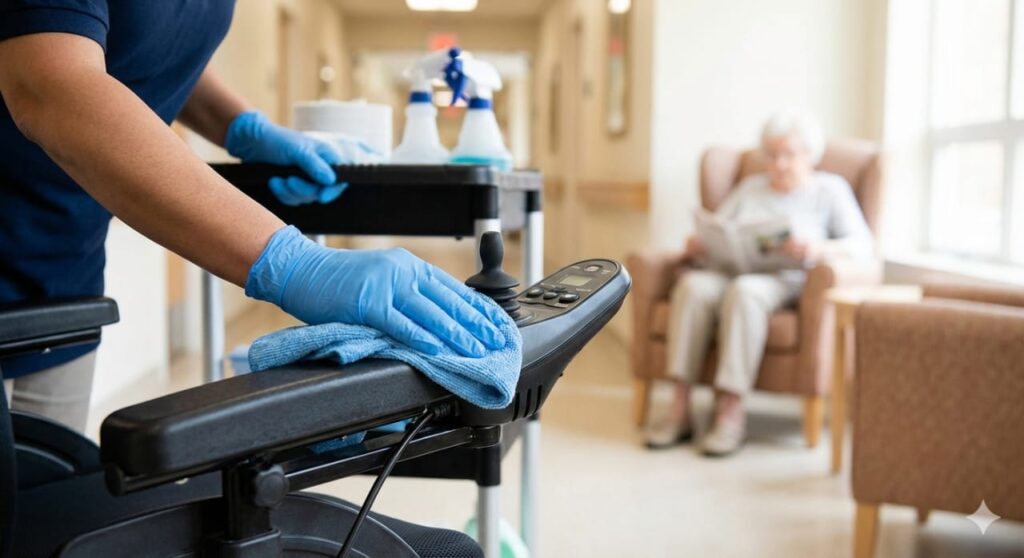
Then there is the profound power of environment. I watched housekeeping with a new respect. They weren’t just cleaning; they were disinfecting with a precise, scientific rigor.
High-touch surfaces, doorknobs, railings, remote controls, call buttons were not cleaned on a schedule, but on a frequency that acknowledged their constant use.
The carts carried color-coded cloths, ensuring a rag used in a bathroom never touched a surface in a dining area. This meticulous, systematic approach turns the entire facility into an environment that actively fights microbial life.
But perhaps the most critical layer is the human one: early detection and compassionate isolation. The nursing staff developed an almost sixth sense for the subtlest changes, Mrs. Jones is less chatty at breakfast, Mr. Smith didn’t finish his pudding.
These tiny deviations can be the earliest signal. When a resident did show signs of illness, the protocol wasn’t treated as a punishment. I saw a resident with a suspected infection moved to a beautiful, sunlit isolation room with the same photos and knick-knacks from their own space brought in.
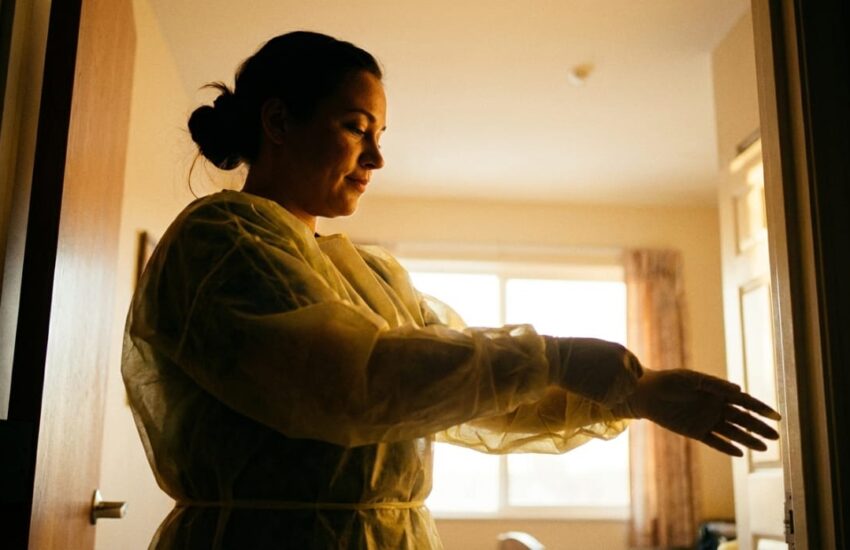
Care didn’t stop; it intensified, delivered with full PPE but also with extra kindness and reassurance through the mask and face shield. The goal was to contain the germ, not isolate the heart.
Finally, a comprehensive program knows it cannot operate as a fortress. It must extend its walls to include every visitor, every volunteer, every delivery person.
Clear, compassionate communication is key. We received gentle, firm reminders about vaccination requirements, current outbreak statuses, and hand hygiene upon entry. It framed our visit not as an intrusion on rules, but as a partnership in protecting a community we loved.
Implementing this isn’t about writing a perfect manual. It’s about building a living culture where safety is woven into every interaction, every routine, every breath.
It’s about empowering every single person in the building, from the director to the dietary aide, to see themselves as an essential part of this shield. It requires investment, in technology, in training, in staffing levels that allow for this vigilant care.
During that flu season, my father’s home had cases, but they didn’t have devastation. The outbreak was contained to a single wing, managed with calm efficiency.
That was the dividend of their unseen work. A comprehensive infection control program is the ultimate act of respect for our elders.
It declares that their golden years deserve to be protected not just with medicine and meals, but with a scientifically-sound, human-centered determination to keep them safe from the invisible threats that seek them most.
It is the quiet, daily work of love, made manifest in clean hands, clean air, and unwavering vigilance.
References
Bloch, N., et al. (2023). *Effective infection prevention and control measures in long‑term care facilities: A systematic review*. *Antimicrobial Resistance & Infection Control, 12*(1), Article 112. https://pmc.ncbi.nlm.nih.gov/articles/PMC10585745/
Centers for Disease Control and Prevention. (2024, July 14). *CDC’s core infection prevention and control practices for nursing homes and other long‑term care facilities*. Retrieved from https://www.cdc.gov/infection-control/hcp/core-practices/index.html
Multisociety Expert Panel. (2025). *Multisociety guidance for infection prevention and control in nursing homes*. *Infection Control & Hospital Epidemiology, 46*(10), 1123–1145. https://pmc.ncbi.nlm.nih.gov/articles/PMC12620066/
World Health Organization. (2023). *Environmental cleaning and infection prevention in health care facilities: Trainer’s guide and learner’s guide*. Retrieved from https://www.who.int/publications/i/item/9789240051065
Agency for Healthcare Research and Quality. (n.d.). *A unit guide to infection prevention for long‑term care staff*. Retrieved from https://www.ahrq.gov/hai/quality/tools/cauti-ltc/modules/resources/guides/infection-prevent.html