
 Posted by
 Providing specialized care for Parkinson’s disease in nursing homes is crucial. Learn about medication timing, mobility support, fall prevention, and communication strategies for residents with PD. Caring for a resident with Parkinson’s disease requires more than a general understanding of aging; it demands a specific, nuanced expertise that honors the person behind the progressive neurological symptoms.
Parkinson’s is a complex symphony of motor and non-motor challenges, rigidity, tremor, bradykinesia (slowness), gait instability, alongside depression, cognitive changes, and autonomic dysfunction. In a nursing home setting, a standardized approach can inadvertently worsen symptoms and diminish quality of life.
True care for Parkinson’s means building a flexible, responsive environment and routine around the individual’s unique and fluctuating needs, empowering them to live with dignity and maximal function for as long as possible.
The cornerstone of managing Parkinson’s is the precise and timely administration of medication, most commonly levodopa/carbidopa. For residents, timing isn’t just about adherence; it’s about functionality. Medications work in cycles, creating “on” periods of relative mobility and “off” periods of severe stiffness and immobility.
The nursing staff must be meticulously trained to administer medication *on schedule*, often as close as 30 minutes before planned activities like meals, therapy, or socialization. Coordinating all care, bathing, dressing, transfers, within these “on” windows is critical.
Furthermore, high-protein meals can interfere with levodopa absorption, so the dietary team must collaborate to schedule protein-heavy meals away from peak medication times, ensuring the resident gets both the nutrition and the drug efficacy they need.
Safety and mobility support require environmental adaptations that anticipate the specific challenges of Parkinson’s. Fall prevention is paramount, as residents are at high risk due to postural instability, freezing of gait, and orthostatic hypotension. Environments must be clutter-free, well-lit, and equipped with sturdy furniture.
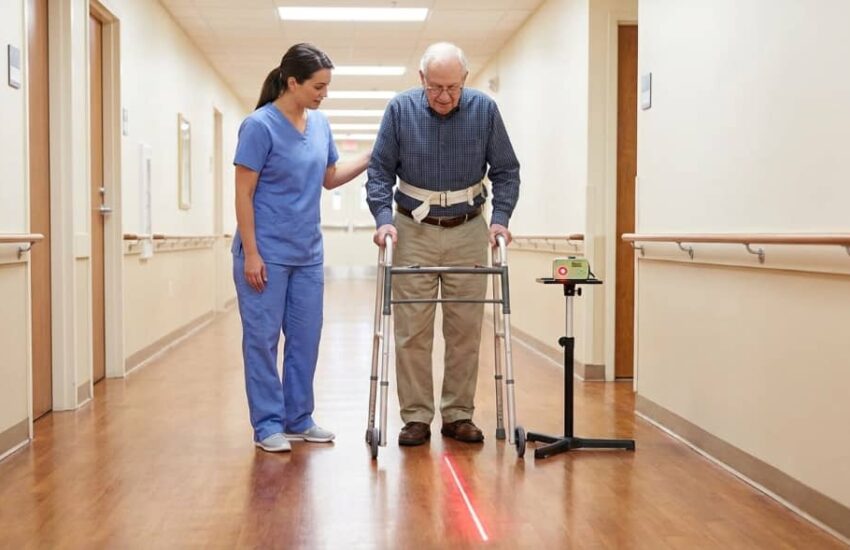
Simple cues like placing contrasting colored tape on the floor can help overcome freezing episodes. Physical and occupational therapy are not optional; they are essential for maintaining strength, balance, and the ability to perform daily activities.
Therapy should focus on cueing strategies (using auditory or visual prompts to initiate movement) and teaching staff safe, effective transfer techniques that don’t trigger rigidity. The goal is to support movement, not do it for them, preserving independence and motor pathways.
Perhaps the most overlooked aspect is addressing the profound non-motor symptoms. Depression and anxiety are common and require active screening and treatment. Cognitive changes or dementia (Parkinson’s disease dementia) may emerge, necessitating a shift in communication to simple, direct language and consistent routines.
Swallowing difficulties (dysphagia) pose a silent risk of aspiration pneumonia, requiring speech therapy evaluation and modified diets. Constipation is almost universal and requires proactive management. Staff must be educated to see these as core features of the disease, not unrelated complaints.
A resident refusing to eat may be depressed, unable to swallow safely, or simply unable to get their stiff hand to their mouth during an “off” period, each cause requires a different, informed intervention.
Ultimately, addressing the needs of a resident with Parkinson’s is an exercise in deep empathy and partnership. It involves listening, not just to their words, which may be softened by hypophonia (low voice volume), but to their body’s language.
It means planning the day around their internal pharmacological clock. It requires a team, nursing, therapy, dietary, social work, and activities, communicating closely to create a seamless web of support.
By moving beyond a reactive model of care to one that is proactive, personalized, and informed by the rhythms of Parkinson’s, a nursing home can transform from a place of managed decline into a community that actively supports living well with a complex condition, honoring the full humanity of each resident every day.
References
Parkinson’s Foundation. (n.d.). *Finding the right skilled nursing facility* [PDF]. Retrieved from https://www.parkinson.org/sites/default/files/documents/skilled-nursing-facility.pdf
Matsuda, S., et al. (2022). Home health nursing care time for patients with Parkinson’s disease. *Healthcare, 10*(5), 834. https://doi.org/10.3390/healthcare10050834
Marie Curie. (2024, June 27). *Caring for someone with Parkinson’s at the end of life*. Retrieved from https://www.mariecurie.org.uk/professionals/palliative-care-knowledge-zone/parkinsons
A Place for Mom. (2025, February 6). *Assisted living and Parkinson’s disease*. Retrieved from https://www.aplaceformom.com/caregiver-resources/articles/parkinsons-disease-and-assisted-living
Nurseslabs. (2025, November 27). *Parkinson’s disease nursing care plans*. Retrieved from https://nurseslabs.com/parkinsons-disease-nursing-care-plans/