
 Posted by
 Learn essential strategies for caring for nursing home residents with vision or hearing loss. Discover communication techniques, environmental adaptations, and activities to promote dignity and connection.
In the communal world of a nursing home, the ability to see a friendly face, hear an announcement, or feel a guiding touch shapes the entire experience of safety, connection, and autonomy.
For residents living with sensory impairments such as vision loss from macular degeneration or hearing loss from presbycusis, this world can become fragmented, confusing, and isolating. Standard care protocols often assume intact senses, creating daily hurdles that range from miscommunication to increased fall risk.
Providing truly person-centered care requires moving beyond general assistance to a dedicated, empathetic approach that rebuilds the bridges between the resident and their environment, ensuring they remain engaged, respected, and empowered.

The journey begins with a fundamental shift in communication. For residents with hearing loss, this means staff must master simple but vital techniques: always facing the resident directly in good light so they can read lips and facial expressions, speaking clearly at a moderate pace without shouting, and using touch gently to gain attention before speaking. Written notes, picture boards, or tablet apps with large text can be invaluable.
For those with vision loss, verbal narration becomes essential. Staff should announce themselves upon entering a room, describe the location of items on a meal tray (“Your coffee is at two o’clock”), and explain what they are about to do before providing care (“I’m going to take your blood pressure now; you’ll feel the cuff on your left arm”). This practice, known as “see-for-me” communication, replaces visual information with verbal detail, restoring a sense of predictability and control.
The physical environment must be intentionally adapted to be navigable and intuitive. For the visually impaired, this involves maximizing contrast and reducing clutter.
Placing a dark-colored chair against a light wall makes it visible; using brightly colored tape on the edge of steps defines the boundary. Ensuring consistent, obstacle-free pathways and keeping furniture in fixed positions is critical for safe navigation. Auditory cues are equally important: installing flashing light alerts for fire alarms or door knocks, and ensuring telephones and call bells have adjustable, loud volumes and distinct tones.
For all residents, but especially those with sensory loss, a predictable routine is a form of environmental adaptation. Knowing that lunch always follows the morning news, or that a favorite activity happens in the same room every Tuesday, provides a mental map that reduces anxiety and confusion.
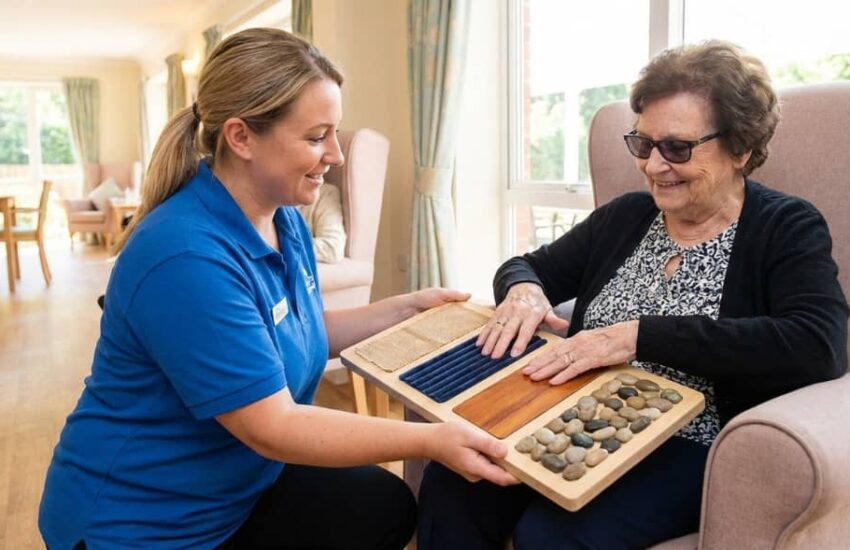
Care extends beyond basic needs to fostering meaningful engagement and cognitive health. Isolation is a profound risk when sensory channels are impaired. Activities must be adapted: offering large-print books and audiobooks, providing tactile puzzles or knitting projects, and facilitating music therapy with an emphasis on vibration and familiar melodies.
Technology, like tablets with zoom and voice-over functions or personalized music playlists with high-quality headphones, can open new windows to the world. Most importantly, staff must be trained to proactively facilitate social connection.
This might mean introducing a resident with hearing loss to a potential friend during a quiet activity rather than a noisy social hour, or guiding the hand of a resident with vision loss to a shared gardening project, making participation possible through touch and shared action.
Ultimately, caring for residents with sensory impairments is an exercise in empathy and advocacy. It requires staff to constantly inhabit the perspective of the resident, asking, “What can I not perceive in this moment?” It means advocating for proper assessments for hearing aids or low-vision specialists, and ensuring devices are clean, charged, and properly fitted.
This approach does more than prevent accidents; it validates the resident’s experience and fights the loneliness that can accompany sensory loss. By thoughtfully adapting communication, environment, and activities, a nursing home communicates a powerful message: “We see you. We hear you. Your world here is designed for you to live fully in it.” This commitment transforms care from mere assistance into a true partnership in navigating the world.
References
National Institute for Health and Care Excellence (NICE). (2013). *Quality statement 4: Recognition of sensory impairment*. Retrieved from https://www.nice.org.uk/guidance/qs50/chapter/quality-statement-4-recognition-of-sensory-impairment
Schofield, P., et al. (2014). Sensory impairments in community health care: A scoping review. *Journal of Multidisciplinary Healthcare, 7*, 235-245. https://pmc.ncbi.nlm.nih.gov/articles/PMC4045259/
Jeon, Y. H., et al. (2024). The relationship between sensory impairment and home care service use among older adults: A systematic review. *Journal of Advanced Nursing, 80*(5), 1890-1905. https://doi.org/10.1111/jan.15863
Care England. (2023). *Sensory loss in care homes: Diagnosis, awareness, response*. Retrieved from https://www.careengland.org.uk/sensory-loss-care-homes-diagnosis-awareness-response/