
 Posted by
 Confused about senior housing? Our guide explains Independent Living, Assisted Living, Memory Care, Nursing Homes, and Continuing Care Retirement Communities to help you find the right fit. The search for the right senior housing often begins with a growing realization: the family home is no longer the perfect fit. Perhaps maintaining a house has become overwhelming, or there’s a need for more social connection, or some daily tasks now require a helping hand. This moment, while daunting, is also an opportunity, a chance to choose a new living environment designed to support safety, community, and well-being. The landscape of options is vast, from vibrant communities for active adults to specialized care settings. Understanding the key differences is the essential first step in finding a place that feels like home while providing the appropriate level of support.
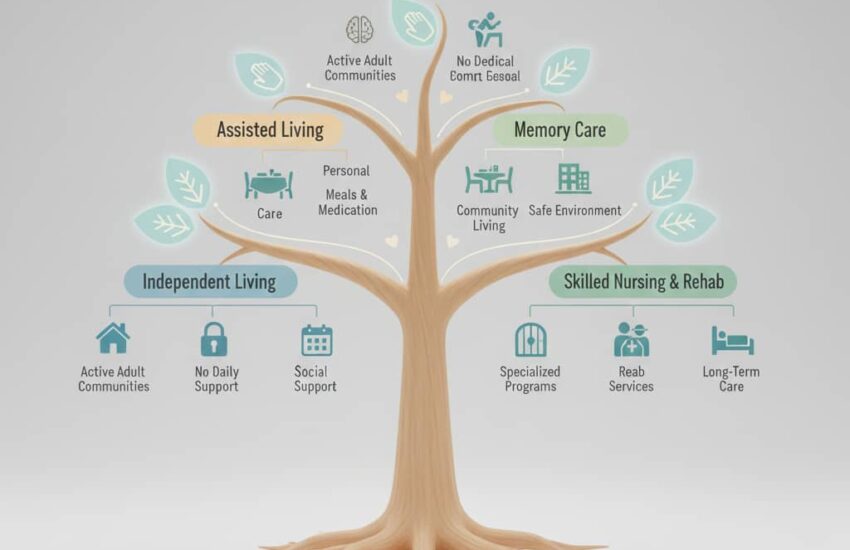
For those who are largely independent but seek freedom from home maintenance and the benefits of an active community, Independent Living is the ideal starting point. Think of it as a resort-style community for adults typically aged 55 and older. Residents live in private apartments or cottages and enjoy amenities like dining halls, fitness centers, scheduled transportation, and a full calendar of social activities. The focus here is on lifestyle, convenience, and socialization, not on personal care. It’s a perfect choice for seniors who are healthy and active but want to simplify their lives and be part of a peer group.
When independence begins to wane due to challenges with daily activities like bathing, dressing, medication management, or mobility, Assisted Living provides the necessary support. Residents still have their own private apartment, but they also have access to 24-hour staff who provide personalized care plans. Assistance is offered as needed, promoting dignity and autonomy while ensuring safety. Meals, housekeeping, and activities are included, along with coordination of healthcare services. This model bridges the gap between independent living and more intensive medical care, offering a social environment where help is always discreetly available.
For individuals living with Alzheimer’s disease or other forms of dementia, a specialized environment is critical. Memory Care is a secure, structured setting within an Assisted Living community or as a stand-alone facility. It is specifically designed with safety features to prevent wandering and layouts that reduce confusion. Staff receive specialized training in dementia care, and programs are tailored to stimulate cognition and engage residents at their ability level. The focus is on providing a calm, predictable, and supportive environment that manages symptoms and maximizes quality of life, offering peace of mind to families.
When a person requires constant, skilled nursing care and frequent medical attention, a Nursing Home provides the highest level of non-hospital care. Also called skilled nursing facilities, they are staffed with licensed nurses and therapists 24/7. Residents may have complex medical needs, be recovering from surgery or a serious illness, or require comprehensive assistance with all activities of daily living. While some offer short-term rehabilitation stays, many provide long-term custodial care in a more clinical setting than Assisted Living, focusing on medical management and essential daily support.
For those planning ahead, a Continuing Care Retirement Community offers a comprehensive, long-term solution. These campuses combine Independent Living, Assisted Living, and Nursing Home care all in one location. A resident can move in while independent, enjoying an active lifestyle with the security of knowing that if their health needs change, they can transition to higher levels of care within the same familiar community and without a disruptive move. This model provides unparalleled continuity and peace of mind, though it typically requires a significant upfront entrance fee in addition to monthly costs.
Choosing the right option requires an honest assessment of current and foreseeable needs, a clear understanding of finances, and, most importantly, visits to potential communities. The right fit should not only meet care requirements but also feel welcoming, engaging, and respectful, a true home that supports the next chapter of life with dignity and grace.
References
Elderly Health Service, Department of Health. (n.d.). *Helping elders adjust to long term care*. Hong Kong Government. Retrieved from https://www.elderly.gov.hk/english/service_providers/helping_elders.html
Groenvynck, L., et al. (2021). Interventions to improve the transition from home to nursing home: A scoping review. *Gerontology and Geriatric Medicine, 7*. https://doi.org/10.1177/23337214211001498
Federal Ministry of Humanitarian Affairs, Disaster Management and Social Development. (2023). *National policy on ageing*. Government of Nigeria. Retrieved from https://www.fmhds.gov.ng/wp-content/uploads/2023/03/NATIONAL-POLICY-ON-AGEING-FMHADMSD-VERSION-1.pdf
American Academy of Family Physicians. (2022, November 14). *Care transition and long-term care options for older adults*. Retrieved from https://www.aafp.org/pubs/afp/issues/2022/1100/curbside-long-term-care.html
Health and Care Professions Authority. (2018). *The transition of older people from their own residence to a care home*. Retrieved from https://www.hcpa.info/wp-content/uploads/2018/08/The-Transition-of-Older-People-from-their-own-Residence-to-a-Care-Home.pdf